
 They don’t have thumbs
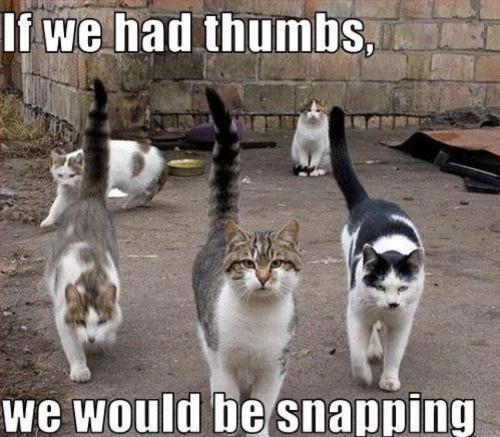
And a lot of them are starving.
The homeless cat wandered up to my porch, looked me straight in the eye, and said ‘Miaow!” She had kittens somewhere, by the pink, swollen nipples on her underside. She was otherwise emaciated and had lost most of the hair on her back. “Miaow.” She rubbed her thin body against my legs.
I gave her a bowl of dry catfood borrowed from my Elvis the Giant Kitty, who uncharitably took a very dim view of his food going to another cat. It was as if I was cheating on him, he claimed. But she was starving.
After she ate the bowl of dry food, I further incensed Elvis by giving her spoonful of wet cat food. She took the whole spoonful into her mouth and took off. Not in fear that the delectable, meaty, aromatic chunk would be stolen from her, as I first assumed before it dawned on me she was taking it back to her kittens.
The next morning I’m on the porch with my coffee, watering my desert flower garden, and the mother cat led her four kittens into my yard, where they licked the water droplets off the plants that had been watered. NExt she led them to the porch. I understood that I was to go into the house and bring back a cookie sheet of Elvis’s sacred catfood.
She and the four kittens ate until full, while I—devastated my the extreme cuteness of the kittens, and the heroism of their mother. I watched them grow over the next several weeks, smiled in amusement at the mother when she decided it was time to wean them. She was quite nasty about it, hissing and swiping at them.
I noticed a few male cats hanging around and considered that weaning the kitties meant mama is going into heat soon. I did a little math: another four kittens makes eight, they’re all going to be reproducing soon. And they’re all homeless. Just what the neighborhood needed, an exploding cat population.
I discovered a program called the Street Cat Companions in Albuquerque, sponsored by the New Mexico Animal Friends, whose mission is to control exploding cat populations by trapping feral and homeless cats, and having them them spayed and neutered. A sort of MASH clinic for cats was held at the New Mexico Animal Humane Association animal hospital on the 3rd Sunday of every month, staffed by volunteers—veterinarians, vet techs, and volunteers like me.
My job was to take the cat’s temperature after surgery, clean the blood off and swab an antibiotic over the wounds, check them for fleas, and pass them on to the next volunteer, who vaccinated them against the common domestic animal diseases. Lastly they were given a pain-killer, while getting re-hydrated intravenously.
The cats spent several hours in recovery cages while the anesthesia wears off and to make sure they don;t have any adverse reaction after surgery.
And after that?
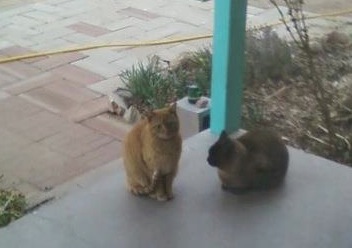
The cats are released back onto the street, unable to reproduce. While we gave them the worst day of their lives n the cat MASH unit, and it doesn’t seem as if our efforts reduce the total number of cats in the US, the 9 cats in my neighborhood that had the worst day of their lives in the MASH unit, were happy to be back in their lives, on the street.
 Mary C Simmons
You must be logged in to post a comment.