Rockin’ on down the road to Enlightenment..

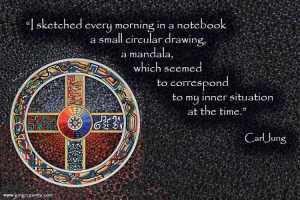
Late last year on one of the social media sites, I was inspired by this poster—words from the great psychoanalyst Carl Jung which reads:

“I sketched every morning in a notebook a small circular drawing which seemed to correspond to my inner situation at the time”

My inner situation was to start the day so splendidly.  In meditation. Drawing meditation — a spiritual practice, centered within my own self, rather than the ravages of life in America in 2018 as reported incessantly by social media, news media, comedy media, bullcrap media…

The Mandala Project
I replace it all with Mandala Media—or perhaps Mary Media, though some would argue my inner being, the being whom I truly serve is probably not named Mary. Do our inner beings have names, I wonder? Names that survive our current incarnations?

No matter. Mary has worked well my entire life, in spite of the still, though thankfully occasional, references to nursery rhymes with gardens and contrariness.

Everyone knows what a mandala is, right? —from the Sanskrit, loosely translated as “circle”?

That’s the short definition, which I would come to find useful…but most of us probably think mandalas are a bit more than ‘just a circle’. We want more from a mandala than that.

Man·da·la — ˈmandələ/
noun: mandala;
-geometric figure of a circle enclosing a square, representing the universe.
-in Psychoanalysis: a symbol in a dream, representing the dreamer’s search for completeness and self-unity.

I see. The Universe and self-unity. And the dreamer is… the one who draws the mandala.

That works.

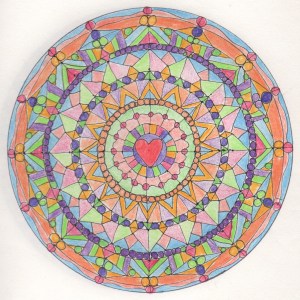
So I draw a mandala every day —  with ink and colored pencil on paper.  Free hand, but for the inner and outer circles, which are drawn using a template.

The rest is my hand, my focus, my intention.The images of the mandalas flow to me and through me, while I enjoy the patterns and the colors issuing forth from pen and pencils.  Emerging first, hearts and stars and squares of ever-increasing symmetry organized themselves in
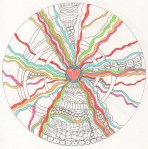
symmetrical patterns of triangles and stars. The endless variety of possibilities of color and structure ultimately leads to the energy flows of the universe.
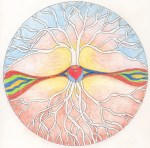
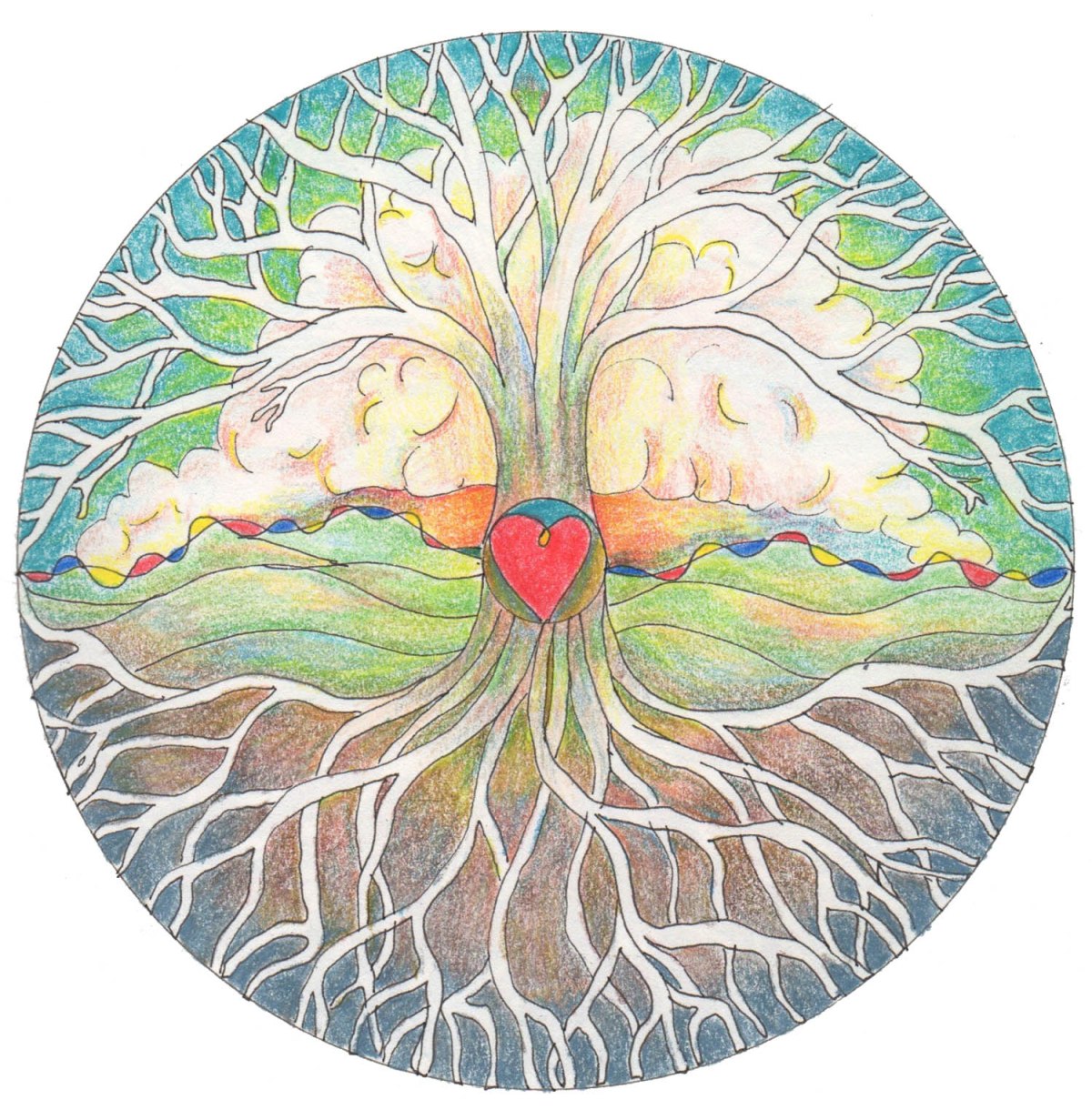
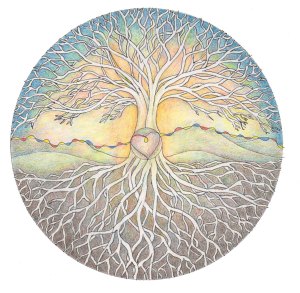
Outside, the flowers bloomed and finally, finally I understood that we are, like the flowers and trees, nourished from below and above— with the gifts of the physical earth, and the invisible flows from above, through the energy of sun, wind and eternal sky. Which gave birth to the quintessential mandala…

Tree of Life
The Temple of My Imperfection – 2019

Here we go again…—that moment when you finally realize that all your efforts toward achieving perfection will never be enough.

Seizing the Wabi-sabi

 Wabisabi (侘寂) represents a comprehensive Japanese world view or aesthetic centered on the acceptance of transience and imperfection. -Wikipedia

crProbably wabi-sabi was first named for what happens to pottery subjected to the hellish temperatures in kilns, around 2,000ºF (~1100ºC). During the firing, the intense heat vibrates all the bonds that hold the minerals together until they come apart, and their constituent ions and molecules cruise around in a melted bubbly mixture that resembles lava, an igneous rock.

The kiln cools, and the pottery solidifies. Sometimes a gas bubble in the glaze pops at that moment and a little crater forms. Or maybe the glaze didn’t come out with a uniform color, or part of it dis-adhered from the pot and crawled away. Or the tea bowl sagged into another pot.

Classic wabi sabi, telling the story of a unique and unrepeatable moment of creation, fired and frozen in time.

Such wabi-sabi moments manifest keshiki–the landscape of the clay; these imperfections do not in any way interfere with the functionality of the piece, and it would be enormously wasteful to throw something useful away because of a surface imperfection.

One over Infinity

SphericalCow2I like to think of firing pottery as a sort of ‘backyard metamorphism’ that changes the pottery, essentially a sedimentary rock, into a metamorphic rock.

I have even made the statement publicly, that kilns are science laboratories in which ceramic artists perform experiments in geology and thermodynamics, which is a branch of science that deals with the advanced secrets of the Universe.

We have learned a great deal about the behavior of matter through experiments that rudely resemble the actual physical universe, tweaked by precise mathematical equations that ignore much of the almost infinite variation therein. Somehow we get close enough that the pieces fit together in rude sorts of ways.

Potter’s kilns on the other hand, much more closely approach the actual imperfection that brought us all the rocks on Earth. And the universe. With a great deal of faith, you consign your piece to the kiln. The wabi-sabi is impossible to know or quantify. There are no round frictionless cows.

Pray to the gods of fire, electricity, gravity and magnetism, that what comes out resembles the vision in your mind. Let me take a moment to calculate the likelihood of that.

One over infinity.

There’s always some wabi-sabi.

A Wabi Sabi Moment with Georgia O’Keeffe

O'Keeffe-(hands)I grew up looking at O’Keeffe art—being that she lived in New Mexico, where I was born and spent most of my life. I’d seen her paintings in books and posters for years. Standing in front of famous paintings in real life—no photograph holds a candle to that experience. It’s not just the colors being more alive, or that you get the true idea of the size of the painting. You are close, very close to the act of creation.
And once, I stood mesmerized in that very moment, as close to a painting as the cops at the Georgia O’Keeffe Museum in Santa Fe would allow. I could not take my eyes off it: a single paintbrush hair embedded in a stroke of color. I felt as if I was there in that one moment when Georgia O’Keeffe stood before this very canvass. A million brush strokes in her long life of painting…and there’s this one that put in that single, unique moment of exquisite wabi-sabi.

It was breathtaking.

I’m glad she didn’t see the hair; surely she would have plucked it out. I would have, in the name of flawless perfection that is found only as a concept within the part of the human brain that dreams of round frictionless cows.

Imperfection: it’s what makes the world

The Hope Diamond
The Hope Diamond

Not even crystals are perfect; they all have wabi-sabi.

They found this one really big chunk of blue diamond, cut all the wabi-sabi away, until it was perfectly huge. Hugely perfect. They called it the Hope Diamond—hoping for another humongous one like it.

One over infinity. It happens. But it’s all the other instances of imperfection that comprise the whole dang universe. The perfect parts are so few as to barely exist at all.

I’ve never made a perfect pot, never wrote a perfect book, never been a perfect anything. I’ll continue to put it out there, though, as long as I have a heartbeat. I am but a fragment of the whole wabi-sabi universe unfolding.

I just don’t know what else to do with myself.

615645dcfad8ce6a1f0e885b6d4ed1fb


Sentience and the Art of Everything

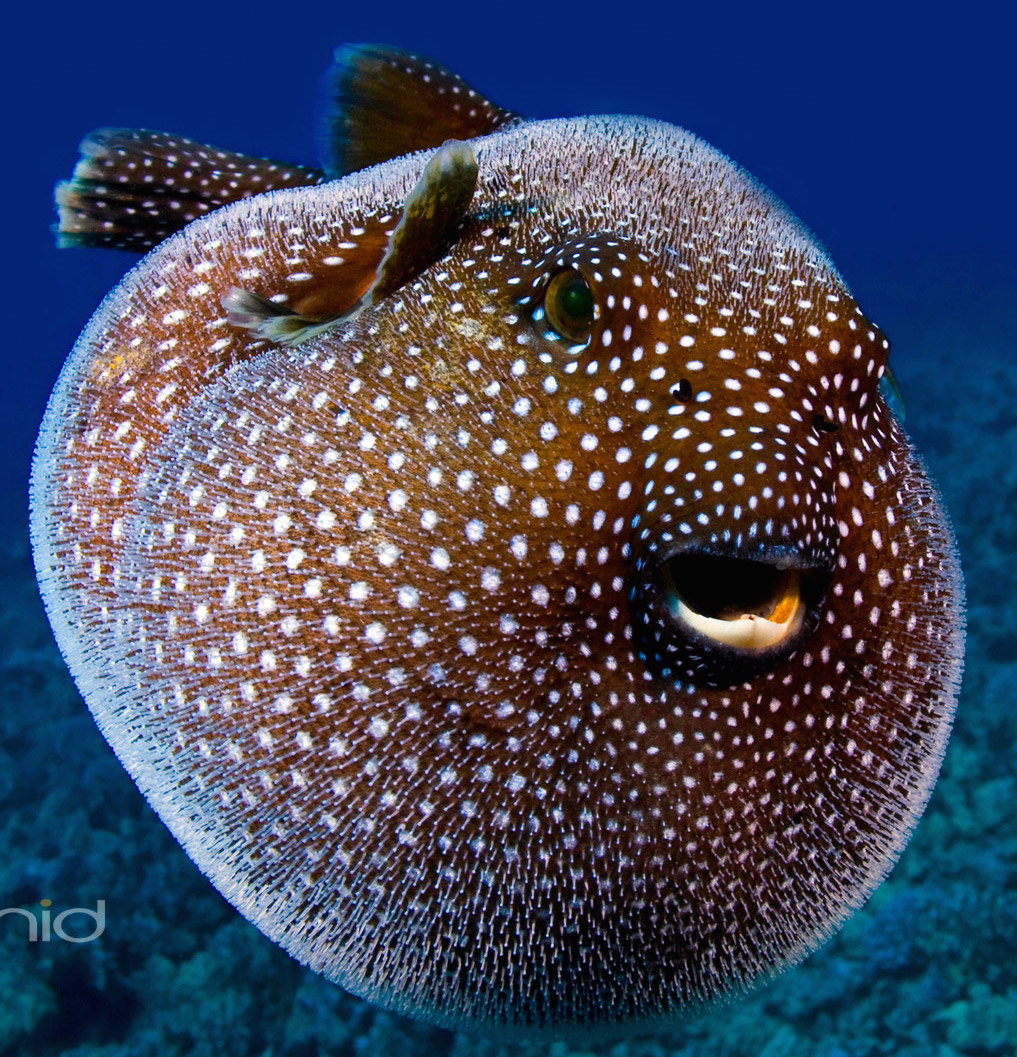
A Guineafowl Pufferfish, Hawaii
A Pufferfish

A recent blog post, And then it was Art, featured a delightful video of a pufferfish creating a work of art in the sand, as if he could somehow visualize what the final piece would look like. That’s what artists do—we create a physical manifestation from an internal vision. Who knew a little fish could do that too? Surely it is not a sign of high intelligence and sentience as in humans, but merely an instinctive mating ritual in the pufferfish.

Heretofore, I’ve been guilty of a quite bigoted attitude, you might even say species-ist, against pufferfish everywhere. I have in a most unaware manner, equated art with superior intelligence and sentience, and discounted the very idea that this tiny fish could be either. For most of my life I have bought into that dogma.

Until the pufferfish came into my life.

What if the pufferfish is actually highly intelligent as well as aware?—but how would we know? When the standard of intelligence is set by us, and has everything to do with our anatomy?

So what is sentience, exactly?

Well, the definition evolves over time, but has nothing to do with intelligence…

And:

sentience (ˈsɛnʃəns) n.

1. the state or quality of being sentient; awareness

2. sense perception not involving intelligence or mental perception; feeling

 Some say that the ability to plan, visualize, and construct is a sign of sentience. That sounds like architecture, actually. Art and engineering combined if we do it; instinct if another animal does.

Just because we can’t hear it scream…

Sense perception means the ability to feel pain and loneliness. And to suffer. I wonder if there is a living creature anywhere that does not feel pain? Or loneliness. Everything that lives probably feels pain. I’m thinking maybe microbes don’t, but how do I know?  Just because they’re microscopic?  Am I again being species-ist, also known as myopic?

BlackCanyonMoss2
Moss Rocks!

EcoArt

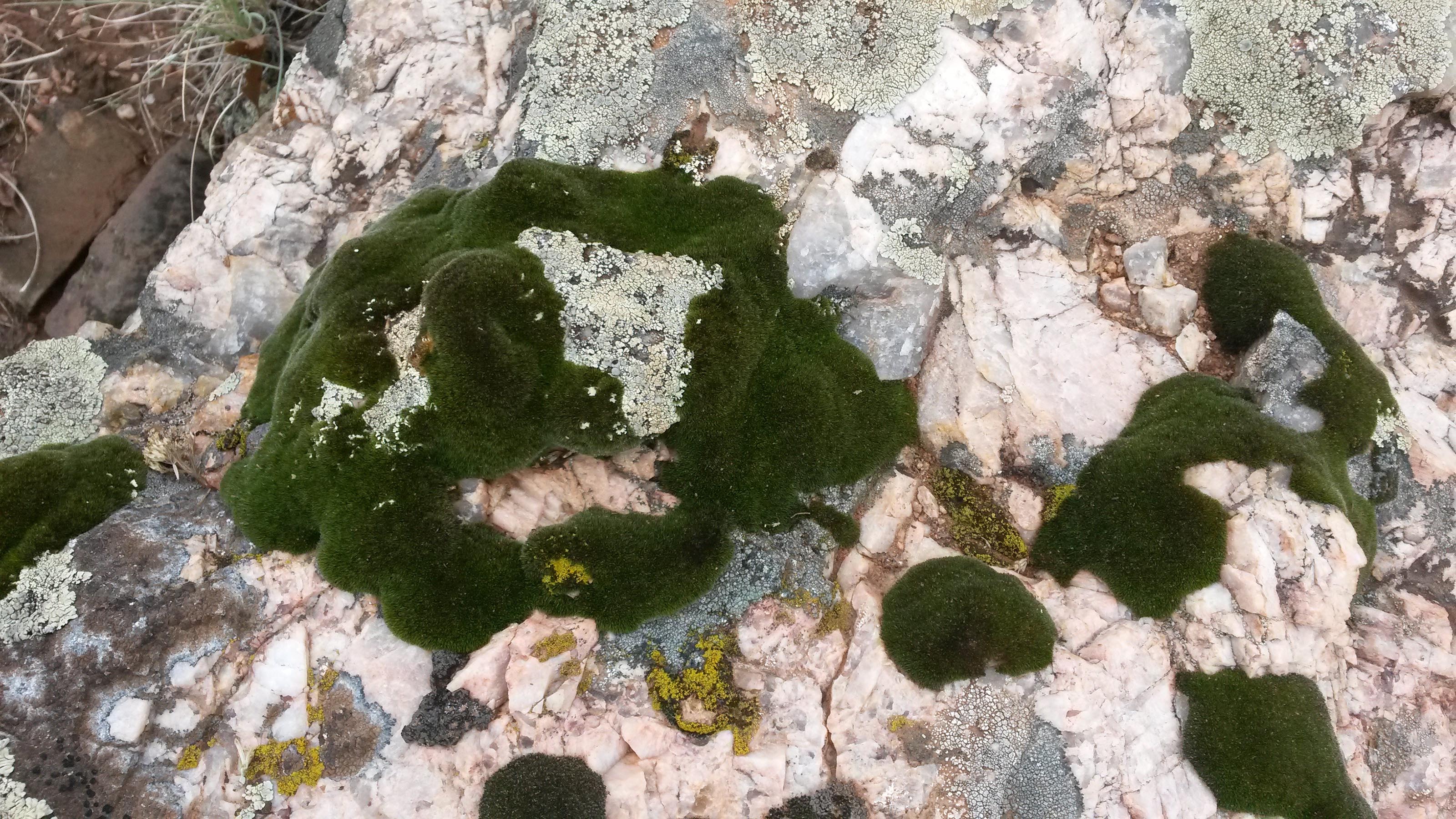
Maybe art and sentience have nothing whatsoever to do with one another. Consider also the lush green moss gracing a quartz and pretty pink feldspar rock called Orthoclase.  As if the moss was painting on the rock. Can we even consider sentience in a plant?

If you take a closer look, past or within the velvety green luscious amazing moss, there’s a few other creatures in the rocks. As it turns out….moss is an allotrope, meaning it’s a primary plant producer upon which the food supply of the entire animal world depends.  Contrary to popular belief, moss does not eat rocks, it attaches to them in order to get water; it’s energy is derived from the sun, as is true of all plants.

BlackCanyonMoss3
Symbionts

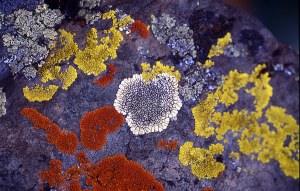
So what’s the lighter green stuff? Not moss, not even plants. They’re the rock eaters, the lithotropes, aka lichen—microbes that feed off the chemical composition of rocks, or whatever they attach to. Lichen form a symbiotic relationship with the moss. Some are pale green, some are yellow, orange, they’re all amazing.

crustose_lichens_lg
Crustose Lichen

Are these creatures aware of their artful expression of living; their unique and endless variations of a verse in the great song of the Universe?
Am I?
Are you?