The Keystone Pipeline and Eminent Domain: legal theft of private property

kelo-v-city-of-new-london-ct-300x201

Private Property and the Public Good

In 1985, Susette Kelo, of New London, Connecticut, lost her home via eminent domain to development by Pfizer, an American multi-national pharmaceutical corporation. It happened, thanks to a divided U.S. Supreme Court decision, Kelo v City of New London (1985), which expanded the definition of ‘public good’ to include increased tax revenues and jobs to the local community. Prior to 1985, ‘public good’ meant things like hospitals, roads, airports–in other words, things that benefit the public.
The sole beneficiary of Kelo v City of New London was Pfizer Corporation. After demanding and destroying the homes of private citizens, however, Pfizer built nothing, provided no new tax revenue, and no jobs. But Pfizer did rip the taxpayers off for tens of millions of dollars. Evidently the ‘public good’ in ‘economic development’ meant the Pfizer Corporation.
No matter what the politicians, corporations, and their lawyers concoct to redefine public good, we all see it for what it is: pickpockets finding a legal way to steal.

keystone.map2_-270x300The Keystone Pipeline

In  today’s news, eminent domain rears its ugly head as an unintended consequence of the Keystone Pipeline project. No matter which side of the political divide you’re on, the government having the right to take your private property to a developer is complete and utter nonsense. Why anyone supports this debacle that will graetly benefit a private corporation in Canada, with dubious to non-existent benefits to U.S. citizens, as well as the potential destruction of our landscape is beyond rationality.

Canada has rules, you see, prohibiting oil pipelines snaking across their land. But not ours. Taking advantage of the absurdity of the Supreme Court decision as well as weakened environmental laws (thanks to the GOP), the non-USA company, Trans Canada Corporation plans to build this controversial pipeline project all across the midsection of our land, and is filing condemnation lawsuits for the property they’ll need for the pipeline all along the way.

Before they even have the permits to build the pipeline.

Trans Canada Corp used the same Supreme Court decision to condemn private property that Pfizer Corp used in the City of New London. Moving oil across a continent is considered ‘for the public good,’ evidently.

These suits are very expensive for a private citizen to fight. Some people, like the Crawfords in Texas, are fighting and have taken to the internet to get some help from the rest of us. A group of Nebraska landowners banded together and have filed suit against their state for selling them out.

Neither God nor Money Can Stop It…

In my ecofantasy novel Corvus Rising, the iconic and enchanted Wilder Island is threatened by an condemnation lawsuit brought by a wealthy developer who has asked the local government to condemn the island under eminent domain and sell it to him. He plans to scrape it clean of the thousands of native birds on the island, as well as all the wild wilderness of  trees, and build a gambling resort open to the public.

That there is a humble yet consecrated chapel on the island, or that the island and the chapel are owned by the Jesuit Order of the Catholic Church, is irrelevant. Neither God nor the wealth of the Vatican can stop Eminent Domain.

Neither in Corvus Rising, nor in 21st century America can even the uber-wealthy Catholic Church stop eminent domain.

As Bad as Citizens United

The one way around eminent domain is public outcry. Let’s hold on to each other’s hands on this rare issue upon which we are not divided. We must stand together, across the political divide. Stand with the Crawfords and all the others in the path of the Keystone Pipeline.

That’s what the birds did, the heroes in Corvus Rising.
gse600-1-300x203

The Ants Go Marching…and marching…and marching

…until death do they part.
………………………………………………………………………………………………………………………………………………………….

Ants-300x240Us and Them

Ever since I wrote Corvus Rising, I’ve considered in great depth and detail how the other living beings on Earth are more like us than not. We humans are fond of viewing our species at the top of the evolutionary ladder that we invented to explain the differences in anatomy and intelligence between Us and Them.

Our species is evidently highly favored: the very Deity we invented created Us to have dominion over Them.

More and more, however, it is apparent that our world view of creation is all wrong.

In the case of the corvidae (crows, ravens, magpies, jays…) we now know that their brains are very nearly the same size as ours (proportional to their bodies) and that they are not only intelligent, but sentient as well. (The Gifts of the Crow, Mazluff, 2012)

And we know that they talk to each other, as shown by Michael Westerfield’s marvelous book, The Language of Crows, whose recordings of crows and ravens dialogs in a variety of situations tells us their speech is not just about looking for a mate to make little corvids with.

Then there’s that little pufferfish, whose connection to the Universe I share. Blows me away. We are all hooked into the same life-giving forces, by whatever deity you or I wish to call it. I like to call it Art.

Them Ants…

Ants are pretty cool; among my favorite books as a child was The City Under the Back Steps—a marvelous story of a couple of kids who magically get shrunk down to ant size.
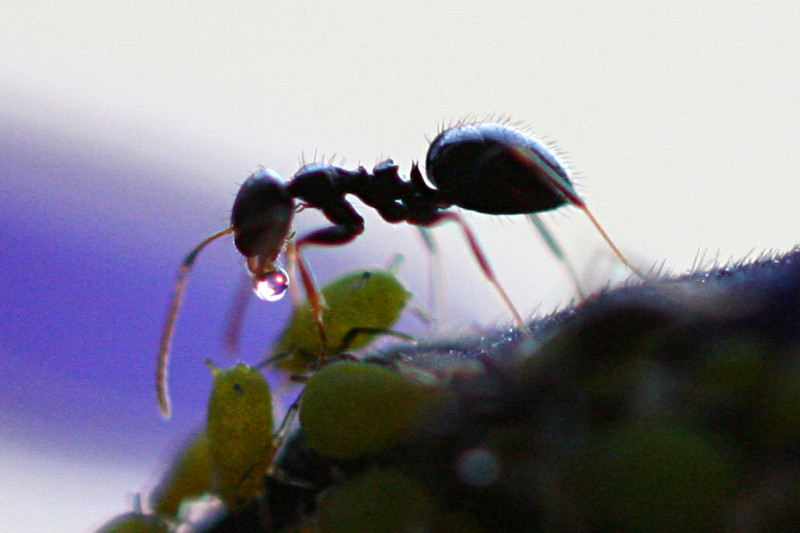
Ant_Receives_Honeydew_from_AphidThe children are shown all around the colony by the ants, and were instructed (as I was) in many of the ways of all ants. For instance: the ants kept herds of aphids and milked them for the sugars the little buggers sucked out of the rosebush. They really do that.  (Read more about how ants milk aphids here…)

Natural science from a fictional children’s book: a marvelous way to learn.

I am a fan of ants, more or less. As long as they don’t invade my house or sting me.

I watched nervously one summer as a gigantic ant colony constructed a subterranean civilization around the size of Denver in my backyard.
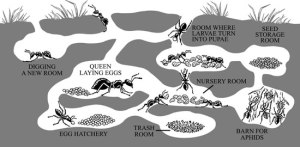
Ant-Farm
Click image for more info about ants & ant colonies

The problem with a humongous ant colony in my back yard: their sheer numbers so close to where I live.  They kept opening up exits and entrances all over the place, including right next to the porch and back steps. Made me nervous.

These are the kind of ants with the big jaws on their heads connected a sack of poison on the other end that is at least a third the size of their whole bodies.
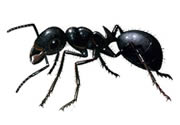
garden_ant_180_tcm9-60508
Black Garden Ant.

Ant bites are bad news. Painful bad news. Every time one injects me with its personal stash of formic acid, it’s worse than the time before. So I am looking a little askance at the city under my back steps. I don’t want them there, but there they are.

And I am outnumbered. Pathetically outnumbered.

My father used to pour gasoline down ant holes and light it. Horrifying. So are pesticides. I do believe the ants have a right to be alive and pursue their ant-like goals. Just not so close to my soft, living flesh.

I didn’t want to kill them. I just wanted them to move. So I flooded them out with the garden hose, a slow trickle of water that filled up the vast network of caverns and passageways. Ants do not have lungs, I reasoned, therefore cannot drown.
But they do float well.
Jillions of ants floated up and out; most found things to cling to and rode the current to edge of dry land where they disembarked.

As soon as I turned off the water, the ants went to work re-building what I had ruined. The next day, I filled the ant hole up again, and ants bubbled up again. When the flood stopped, the ants started building again. I marveled that none of them went belly up on the sidelines, waving their six little legs in the air, otherwise whining and bellyaching about unfair the universe is, or how hard their lives are.

We do that. The animals don’t. They get over it and get on with living.sad-bug-with-napsack-smaller
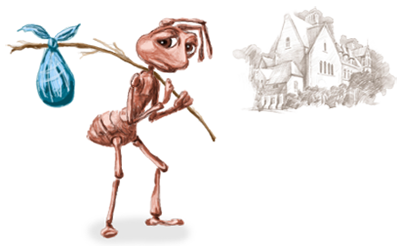
Why can’t we?

The end of the ant story: I kept watering the ant hole and they kept rebuilding. I admired the hell of them. No complaining, no retaliation. Just one foot in front of the other five, and with a pebble in each jaw, they rebuilt.

And I kept destroying. We went on like this for days, me alternately admiring them and destroying them; the ants just kept rebuilding.

Persistence is Everything

They finally moved. They got sick of it, evidently, of spending all their time rebuilding their colony after the continued disaster I brought them. So they moved, lock stock and nursery to the alley behind the house.

Beyond the reach of my hose…

615645dcfad8ce6a1f0e885b6d4ed1fb

The Law is an Ass

abf0c16e325cd1f022ac3a46879258f4A look into some of the many faces of ‘the’ Law…

Man’s Law

That’s the kind of law which governs the Affordable Care Act, paying taxes, stopping at red lights, having to wait until you’re 21 to drink alcohol, as well as all the penalties accrued and assessed for violations.  Man’s Law  also includes a majority of  ‘God’s Laws’—those governing ethical behavior, e.g. the No Kill Law, the No Stealing Law—those things we all just sort of don’t do, as a rule, but just in case we forget, Moses brought the stone table down from the mountain and made it official.

Man’s Law, at least in the US, excludes any and all rules pertaining to False Gods, Swearing, Keeping Holy the Sabbath, and Honoring Your Parents. Oh, and Coveting—we do all get to covet with complete impunity.

Man’s Law governs and includes all judicial decisions. The way that Man’s Law is an Ass can be understood best in terms of a few recent US Supreme Court decisions, e.g.  Kelo v City of New London, 2005, which expanded ‘public good’ to include ‘tax revenue and jobs created by condemning and razing an old lady’s house and building a shopping center.’ Seriously. The government can condemn your property and sell it to a developer.

Citizen’s United v. Federal Election Commisson, 2010. Corporations were given personhood, and therefore the government is prohibited from restricting a corporation’s contribution to political candidates, parties, PACs. Representative government becomes government not of, by, or for the people, but for those with the most bucks. The Monarchy of Money. So much for democracy

Then there’s the Hobby Lobby decision. That’s the one where a company, and presumably a private individual as well, can use a deeply held belief in God’s Law to decide which one of Man’s Laws they don’t have to comply with.

I actually like that one—I can opt out of lots of things on those grounds. Taxes—ain’t gonna pay for war no more.

But, seriously, it’s a whole boxful of Pandoras (a famous saying by former NM Governor Bruce King) that we as a country of 300 million probably don’t really want to let out.

Render unto Caesar?

…that which is Caesar’s and unto God that which is God’s—so says a gospel of Matthew.

smoking+uncle_sam_taxes

And there you have it. Man’s Law is Caesar’s Law—Caesar of course being ‘the government.’ Therefore, the “Render unto Caesar’ rule must extend  to keeping its laws. Except when it’s a privately-held corporation with deeply held religious beliefs, and then God’s Law supercedes. Good thing we don’t think God wants us to stone women of other faiths to death, or fly airplanes into tall buildings.

What if obedience to Man’s Law (or God’s Law) causes or allows suffering of others to continue? Should one steal food to feed one’s hungry children or let them starve? Is this God’s will? Should hungry people get away with stealing food?

Deities can be spectacularly subtle

In my ecofantasy novel, Corvus Rising, the Jesuit priest, Alfredo Manzi, struggles with whether to obey Man’s Law and be considered righteous and without blame, or to commit a criminal act that will alleviate the suffering of another. He prays to God, asking for guidance. Does God want us to break laws? Alfredo wonders, but receives no answer.


CorvusRisingCover2“Deities can be spectacularly subtle,” Charlie the blue-eyed crow tells the priest. “That’s been the corvid observation of human gods in general over the years.”
“As well as spectacularly unhelpful,” Alfredo said as he drew the outline of the grounds of Rosencranz in the sand. “Sometimes God wants us to find our own way, I guess.”
“Well, it might help if you ask a yes or no question,” Charlie said. “Then the deity could catch a bush on fire, which would be a yes answer I would think. However, silence could also be construed as consent, albeit far less dramatic.”                      
-excerpt from Corvus Rising


In other words, sometimes we’re pretty much on our own.


horns-of-a-dilemma