Crows—Inspiring Painters for 15,000 years

I love crows. They inspired me to write a fictional book about them. In doing so, I learned that they are smarter than our species gives them credit for. A lot smarter. They plan dream, love, raise new generations. And they notice us.

But they don’t make art. We do. And we make a lot of it about them.

Though some fear and loathe crows, many of us honor and revere them as intelligent, sentient, creatures; to some of us crows are a source of inspiration. Stroll through my Gallery of Crow Art in its many forms, from famous as well as unknown artists, poets, and writers, living and dead.

Paleolithic Cave Art
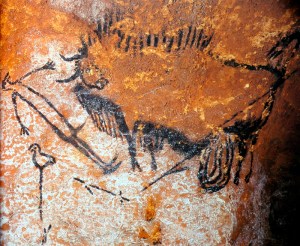
Lascaux-Broken
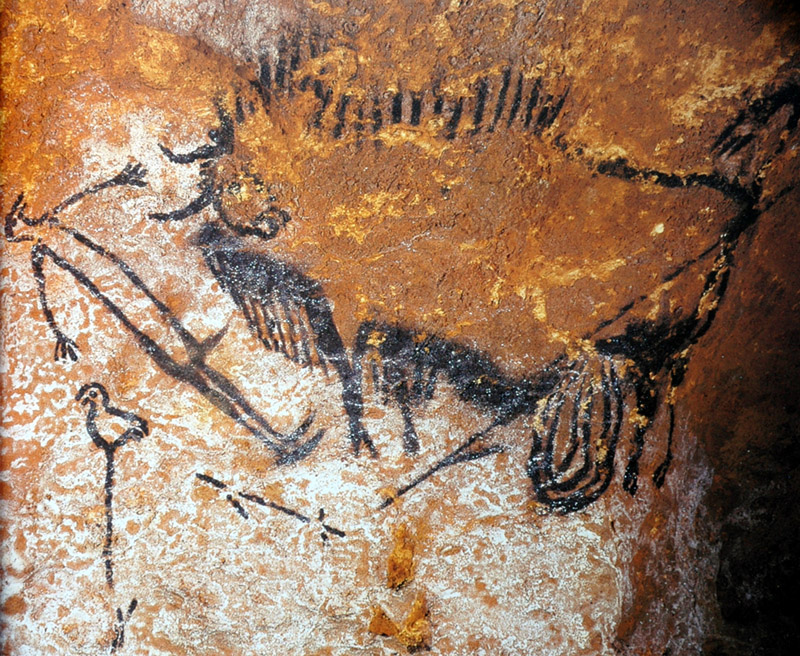
Paleolithic Cave Painting—Lascaux, France
Unknown Artists ~15, 300 B.C.E.

My interpretation of this cave painting: a crow on a perch overlooks a fatal encounter between a human and a big beast. Gored by a spear from this upstart Tool-maker, the beast prepares to impale the naked, hairless human on his horns, while his guts pour out onto the Earth. The crow is waiting for dinner. If it’s not about the Food Chain, it’s just not that important.

Or is it? Many believe the Lascaux cave paintings are star maps of Gemini, Orion, Taurus and Sirius.
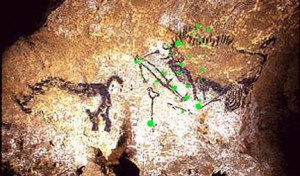
lascaux_stars
http://www.timothystephany.com/stone.html

Wheatfield with Crows, Vincent van Gogh, July 1890

800px-A_Vincent_Van_GoghArt historians believe Wheatfield with Crows-painted just weeks before his death-was van Gogh’s last work.

 “Crows interest themselves in everything, and observe everything. The ancients, who lived far more completely than ourselves in and with nature, found it no small profit to follow, in a hundred obscure things where human experience as yet affords no light, the directions of so prudent and sage a bird.”—Jules Michelet, a favorite author of Van Gogh

Woman with Crow, Pablo Picasso, 1904
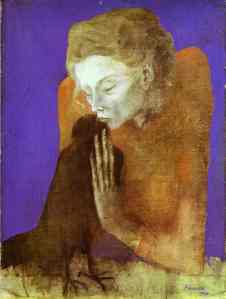
33

Picasso painted Woman with Crow during his Blue Period, at about the same time he moved to Paris. The portrait features Marguerite Luc, whom he knew as Margot kissing and caressing a crow. Margot was the step-daughter of a cafe Picasso frequented.

Georgia O’Keeffe, painted crows too. More than once. She painted Canyon with Crows during the time she lived in Texas and depicts Palo Duro Canyon, whose Permian-aged iron-rich ‘red beds’ became the focal point of the painting. Just before your eyes jump to the crows flying in freedom above the red rocks.

georgia-o-keefee-paintings-canyon-with-crows-1917
Canyon with Crows, Georgia O’Keeffe, 1917

After O’Keeffe returned to New York, she painted Lake George with Crows.

karlins3-25-1
Lake George with Crows, Georgia O’Keeffe, 1921


Oil paint, real feather. Wish it were mine.
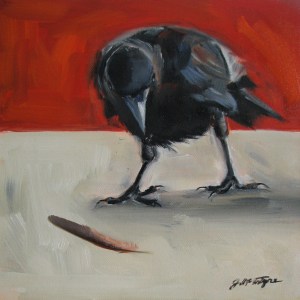
IMG_0042
Crow Painting (Is it Mine?), Jacqueline McIntyre, 2010

The crow is in the painting, the feather is on our side of the canvas. That’s how my imagination works too. Crows step back and forth between it and the world of physical reality. I find their feathers everywhere…
Another unabashed crow-lover:
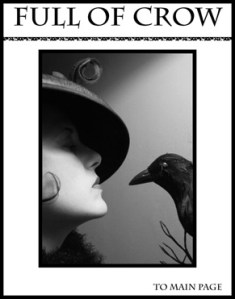
Crow2
Two Crows, Kristin Fouquet, 2010

Kristin Fouquet’s photograph, Two Crows, graces the cover of Full of Crow – “an independent online literary magazine that publishes poetry, fiction, flash, reviews, interviews, articles, art, photography, and more…”

I could go on. And on and on and on….about the ways and means that crows have inspired our species.  But do go ahead and continue looking…Google ‘crow art’ – 62,400,000 hits.

Landscape Paint and the Chemistry Blues

419px-Johannes_Vermeer_(1632-1675)_-_The_Girl_With_The_Pearl_Earring_(1665)Alchemy reigned at the time Johannes Vermeer painted Girl with a Pearl Earring in 1665. Back in that day, before the Periodic Table of the Elementswhich didn’t show up in until 1869—painters made their own paints from the powders of ground minerals by mixing them with linseed oil.

lapis-lazuli-rough
Lapis lazuli

The pigment in the blue scarf around the head of the Girl with a Pearl Earring, for instance, was made from lapis lazuli, a beautiful but rather expensive mineral to be grinding to a powder.  Unfortunately, linseed oil made the fabulous blue color of this beautiful mineral a bit cloudy.

Linseed oil did that to most of the mineral powders, but there was no way around that in 1665. The mineral powders would be chalky-looking and would not flow onto the canvas smoothly without being mixed with linseed oil.

Better Living Through Chemistry

The Periodic Table going public in 1869 moved the job of creating paint from artists to the laboratory chemist. These days, few artists mix their own paints, or even know what’s in them. I’m a big fan of chemistry, for without it, there is nothing. No rocks, no clay, no paint. And I wonder how they make vivid yellow as well as intense red paint from the same thing. Not a mineral, but an element from the Periodic Table: Cadmium.

Modern painters can thank French artist, Yves Klein and a few French chemists, who created a rich luscious blue paint that retained the brilliant blue hue by suspension of the dry pigment in a synthetic resin, avoiding the murkiness of linseed oil.

They called it International Klein Blue. Yves Klein used IKB, as this patented pigment is known, to paint Blue Monochrome, part of a series of one-color paintings he had been creating for several years.

BlueMonochrome
Blue Monochrome, Yves Klein, 1961

IKB represented something profound to Klein: le Vide-the Void. Not a vacuum or terrifying darkness, but a void that invokes positive sensations of openness and liberty, a feeling of profound fulfillment beyond the everyday material world. Standing before Klein’s huge canvases of solid blue, many report being enveloped by serene, trance-like feelings.

That’s how the Southwestern desert landscape makes me feel.

the-surreal-rock-formations-were-created-over-thousands-of-years-as-water-and-wind-eroded-the-navajo-sandstone

The iron-stained colors of my native land inspired me to make paint from it, in the old way—grinding the minerals to a powder and mixing them with linseed oil. Perhaps because these paints are made from desert clays (see my previous blog Desert Paintings), linseed oil did not make them murky.

35321_1346473504741_6813196_n
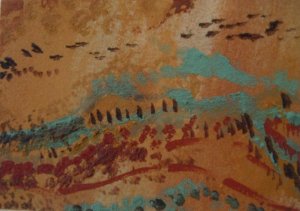
Crows Across the Sky, Mary C. Simmons, 2010


First Crow, First Raven, First Human: Tan Me Hide and Teach Me to Sew


df6c072e1fe5a5ce7fc590df721af24c

First Crow and First Raven had gained a vast storehouse of learned experience in the eons they flew the skies of Earth, well before the first human took a bite of the first apple from the Tree of Knowledge. In the beginning, Raven especially got a big kick out of tricking these silly gullible creatures. They believed anything he said.
“Look! Over yonder, on the horizon! It is the Great Spirit!” Raven would call out and point with one wing. When the humans looked away, Raven swooped down upon them and stole their food. Time after time.

Crow and Raven grew quite fat; they lacked nothing due in large part not to Raven’s trickery, but also because humans were so astonishing wasteful.

“They wouldn’t have to work so hard at hunting and gathering if they didn’t waste so much food.” Crow beaked an eyeball from the severed head of a Big Hairy Beast and swallowed it in one gulp. “They leave so much on the ground for us, which I for one am dreadfully grateful, but if they were more efficient, their food would go further, and they would not have to struggle so to get more.”

“Don’t let them hear you say that!” Raven said, shushing Crow with his wings. He never could leave well enough alone, could not resist wanting to be helpful to these pitiful creatures.

“You see Cousin, in a perfect world, the amount of time we Corvid should spend obtaining food needs to be inversely proportional to the time humans do. That is my famous Inverse Proportionality Rule governing work. Remember? Let’s say they work twice as hard as they have to, which translates into us doing half the work we have. Eh, Cousin?”
Crow’s beady black eyes glazed over, and Raven knew his cousin was only barely listening. But he also needed to remind Crow that his interference in human affairs nearly always backfired. “In other words, dear Cousin,” he said, shaking Crow out of his daydreams of rescue and assistance, “the more they hunt and gather, the less we have to. If they start slacking off, we’ll have to find our own food. No, Cousin. Their wastefulness is our largesse. Think about it. And shut up, please. For the good of us all.”
Crow had always tried to be helpful to the foolish humans. For instance, after they’d hunted and killed the Big Hairy Beast, he had suggested they skin it.
“Why?” the Chieftain asked. “The skin is no good to eat. Too much fur. It is tough and hard to swallow. Even the dogs won’t eat it.”
“No,” Crow said, shaking his head. “You must skin the Beast before you cook him so that you can use his fur to keep yourselves warm.”
The humans stared at Crow, slack-jawed. They hadn’t thought of that; the fire in the spit always burned most of the hair off. They ate the meat, and threw the burnt hide back into the fire.
Crow taught the humans how to carefully slice through the hide up the Big Hairy Beast’s big belly and down the underside of its limbs. The humans learned how to scrape the inside of the hide with a rock, and Crow taught them to boil down the Big Hairy Beast’s brain, which would produce the preservative that would keep the hide from rotting or falling apart.

“You want the biggest pieces of hide you can get,” Crow told them. “Stitching a lot of small pieces together would be very labor-intensive.

“Stitching?” the Chieftain asked, scratching his aching head. “What is stitching?”
“You make needles from his bones, and laces from strips of his hide,” Crow instructed the humans exhaustively and in a day or so, they had managed to not only make a few bone needles, but to thread them as well with long thin strips of Big Hairy Beast hide.
“Now,” Crow said, nodding as the humans finished poking a line of holes through the edges of the hide, “you can attach pieces of hide together, just make sure the holes line up.”
He picked up a threaded needle in his beak and jammed the pointy end into the holes through the two layers of hide. The humans broke into a surprised outcry when they saw him reach underneath the hide and pull the needle through. After poking the needle in one side and out the other a few more times, Crow stood back and said, “And that, my friends, is stitching.”
The humans were sore amazed, but were also clever and deft with their hands, and they stitched together every piece of hide they could find. Soon the whole tribe had fur cloaks, and Crow was very happy to see them all warm and toasty.
To show their gratitude to Crow for bringing the gift of sewing, the humans gave him the head of the very same Big Hairy Beast whose hide they all wore. Crow lugged the head back to the tree in short flights punctuated with a drop to the ground to rest a few moments; the head was heavy and made it hard to fly very far. He dropped the hunk at the bottom of the tree Raven, who didn’t care as much for the company of humans as did his Cousin.
“Cousin,”Raven said after they’d feasted on Beast head, “I have to thank you for the tanning lessons you gave them.”
“Why, thank you! It is good to see the poor things fending off the cold,” Crow said, ever hopeful that compassion had awakened in his cousin’s heart.
“Yes, well that too, I reckon,” Raven replied as he picked small bits of flesh from his feathers. “But the stench of burning Big Hairy Beast hair made me gag.”
And so the great partnership of humans and Corvus continued. As the years went by, Crow and Raven taught the naked and ignorant humans everything they needed to know to survive on Earth.