 Alchemy reigned at the time Johannes Vermeer painted Girl with a Pearl Earring in 1665. Back in that day, before the Periodic Table of the Elements—which didn’t show up in until 1869—painters made their own paints from the powders of ground minerals by mixing them with linseed oil.

The pigment in the blue scarf around the head of the Girl with a Pearl Earring, for instance, was made from lapis lazuli, a beautiful but rather expensive mineral to be grinding to a powder. Unfortunately, linseed oil made the fabulous blue color of this beautiful mineral a bit cloudy.
Linseed oil did that to most of the mineral powders, but there was no way around that in 1665. The mineral powders would be chalky-looking and would not flow onto the canvas smoothly without being mixed with linseed oil.
Better Living Through Chemistry
The Periodic Table going public in 1869 moved the job of creating paint from artists to the laboratory chemist. These days, few artists mix their own paints, or even know what’s in them. I’m a big fan of chemistry, for without it, there is nothing. No rocks, no clay, no paint. And I wonder how they make vivid yellow as well as intense red paint from the same thing. Not a mineral, but an element from the Periodic Table: Cadmium.
Modern painters can thank French artist, Yves Klein and a few French chemists, who created a rich luscious blue paint that retained the brilliant blue hue by suspension of the dry pigment in a synthetic resin, avoiding the murkiness of linseed oil.
They called it International Klein Blue. Yves Klein used IKB, as this patented pigment is known, to paint Blue Monochrome, part of a series of one-color paintings he had been creating for several years.

IKB represented something profound to Klein: le Vide-the Void. Not a vacuum or terrifying darkness, but a void that invokes positive sensations of openness and liberty, a feeling of profound fulfillment beyond the everyday material world. Standing before Klein’s huge canvases of solid blue, many report being enveloped by serene, trance-like feelings.
That’s how the Southwestern desert landscape makes me feel.

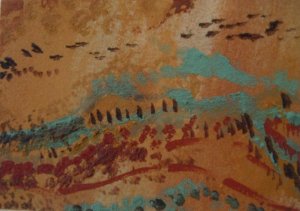
The iron-stained colors of my native land inspired me to make paint from it, in the old way—grinding the minerals to a powder and mixing them with linseed oil. Perhaps because these paints are made from desert clays (see my previous blog Desert Paintings), linseed oil did not make them murky.
 Mary C Simmons
You must be logged in to post a comment.