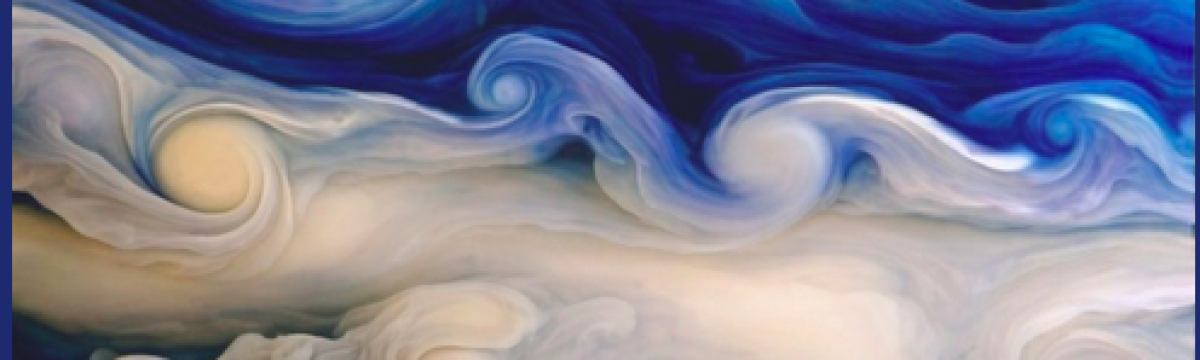
Don’t we all love crystals? the bigger the better?
Not always…sometimes the smallest things are of exquisite beauty.
Microcrystalline Quartz..the Wee Ones
Agates and Jasper are both fine example of Microcrystalline Quartz with spectacularly beautiful patterns and color.
Many people are asking …what is the difference between Agates and Jaspers?
Texture, baby…Texture
And what you may ask is ‘texture’?
Patterns of spheres, spots, banding and mineral alignment or layering.

Agates are banded or show some sort of layering, like the one below…and often translucent.
Jaspers are opaque (no light will penetrate the surface) and are generally not banded

Some folks lump both jasper as a variety of agate. Not me, however…
Some agates are not exactly layered and some jaspers are somewhat banded. And some agates and jaspers have coarsely crystalline quartz within their tiny landscapes of micro-crystals.

Like just about all else in Geology and life in general, the boundary is not razor-sharp but fuzzy and indistinct and we scratch or heads asking, “is it agate or is it jasper?”
One must learn to live with ambiguity.
By the way…those little circular textures in Lace Agate and Ocean Jasper are actually 3-dimensional spheres. What we see in the cut stone are cross-sections through the spheres. Overall, this texture is known to geologists as ‘botryoidal’, a term derived from the Greek word “botruoeidēs”, which means “bunch of grapes”.
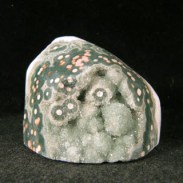
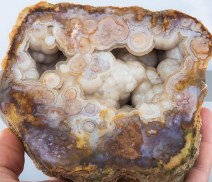
It’s all Chalcedony...
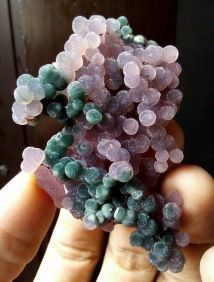
BUT, chalcedony need not be botryoidal, nor layered or banded. Nor is the botryoidal texture limited to chalcedony (e.g. Malachite, Hematite, etc)
So, where do these delicious chalcedony rocks form? Generally in weathering volcanic (e.g. Ocean Jasper…this article is a MUST! -if only for the drop-dead gorgeous pictures), and sedimentary rocks, whether or not the original rock had a lot of silica.
Occasionally chalcedony is found as a petrifying agent in fossils.
As in Dinosaur Bones…
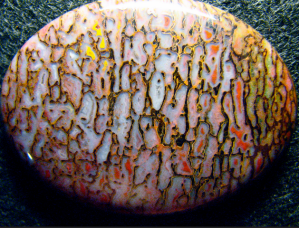 At left is a “gemstone” dinosaur bone cabochon. In the Beginning, Dino bones were made of the same stuff as our bones—largely calcium. After death and extreme burial in the presence of silica and water, the calcium and other bone minerals are replaced with Chalcedony (the whitish and pinkish areas of the stone).
The image below is generally what a dinosaur bone looks like in a thin (30 micron) sections of a rock under polarized light. See Petrographic Microscope.
The image shows a “highly porous structure, with pores filled with late chalcedony, and the fossil remnants of the bone tissue, where black dots used to host a single bone cell. A larger void on the lower left was filled with fine quartz sand. Width of view: 5.3 mm.
Credit: Bernardo Cesare, Department of Geosciences, University of Padova, Padova, Italy”
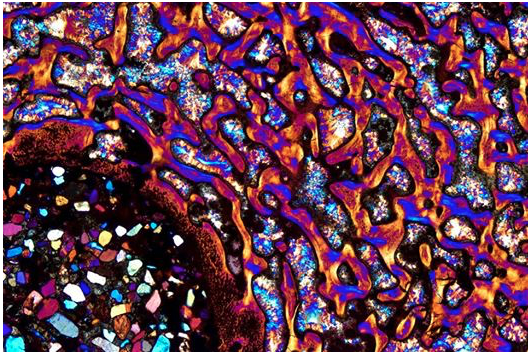
Note: the cabochon of the gemstone dinosaur bone shown above is NOT the same rock as is shown in the photomicrograph, but the two are similar enough to show the chalcedony, regardless of the dino bone it replaced!
Chalcedony, of the Many Colored Flavors
All the agates and jaspers, plus the gemstones Carnelian, Aventurine, Chrysoprase, Onyx, Moss Agate, Dendrite…

Rock on, everyone!
yours, in Quartz
-mary
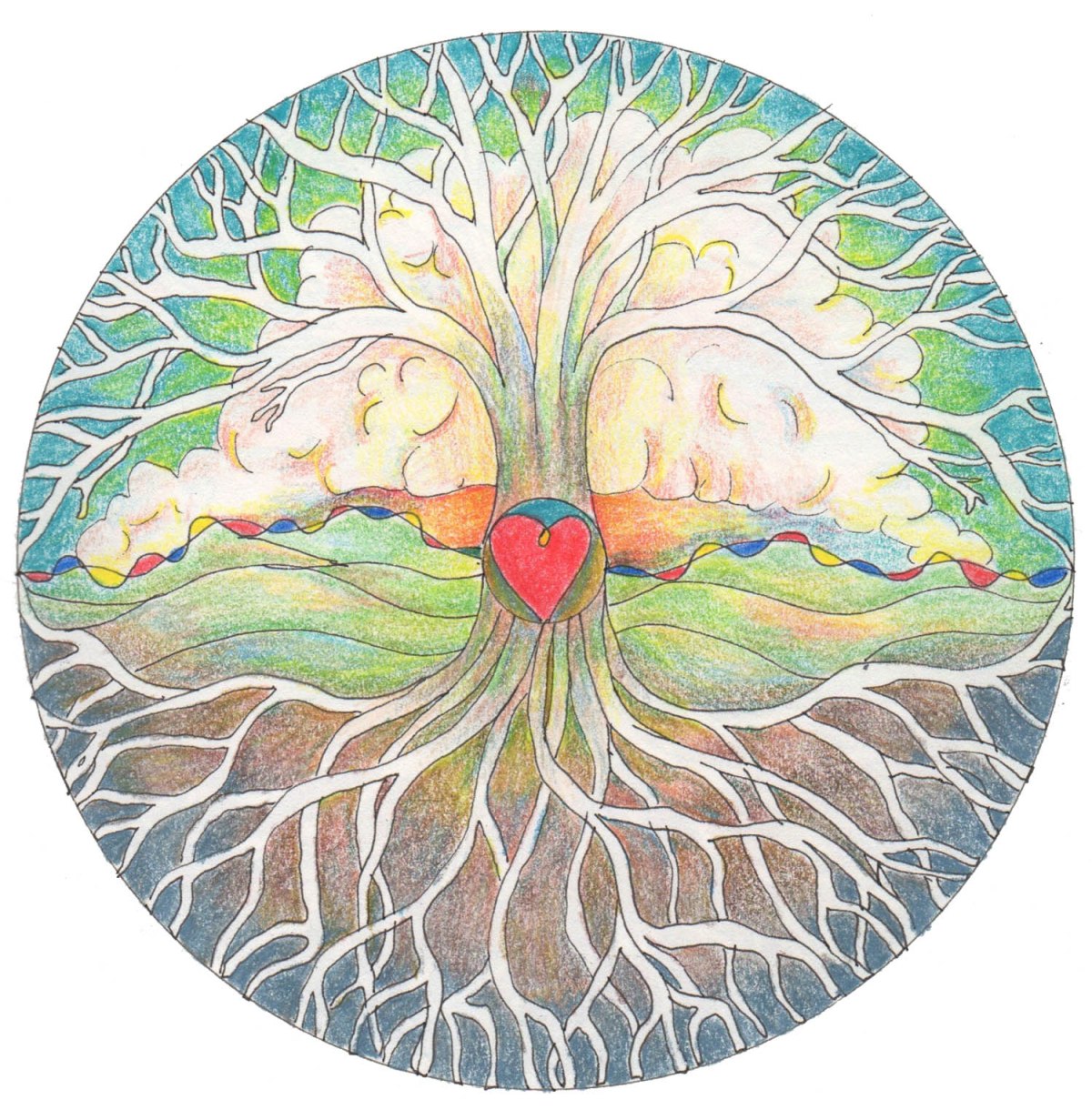
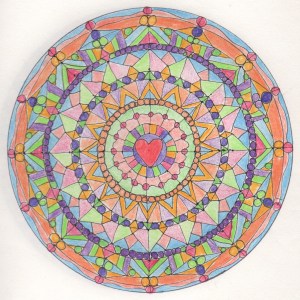


 The rest is my hand, my focus, my intention.The images of the mandalas flow to me and through me, while I enjoy the patterns and the colors issuing forth from pen and pencils. Emerging first, hearts and stars and squares of ever-increasing symmetry organized themselves in
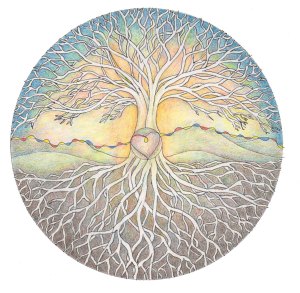
 Mary C Simmons
You must be logged in to post a comment.