I’m fascinated by bones…all bones, especially the white bleached remains of the wild creatures picked clean of all flesh, marking the place where they lay down on the Earth and died.
I am not alone….
Bones of Metal
French artist Phillipe Pasqua designed and fabricated this full-scale, 21 foot tall Tyrannasauras rex sculpture. Comprising 350 bones of chrome and aluminum, the Lizard King towers over the Seine River in France.(Click here for more…)
Bones of Rock
Speaking of T-Rex, a rare nearly complete fossilized skeleton heads for the Smithsonian as the centerpiece for the new dinosaur hall. <more here…>
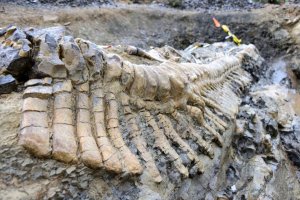
In other bones, Paleontologists recently excavated the fossilized tail of a 72-million year old hadrosaurin the northern desert of Mexico. Discovered by locals, the scientists unburied fifty remarkably well-preserved vertebrae. From these bones, scientists determined the dinosaur suffered from arthritis and tumors (Click here for more…)
Bones of Clay
From molten origins of Igneous rocks, whose feldsparsundergo weathering and disintegration at Earth surface, forming a variety of clay minerals that, thankfully, blanket much of Earth’s surface.
I too am descendent from Firstborn Earth. I know this clay. It is me.
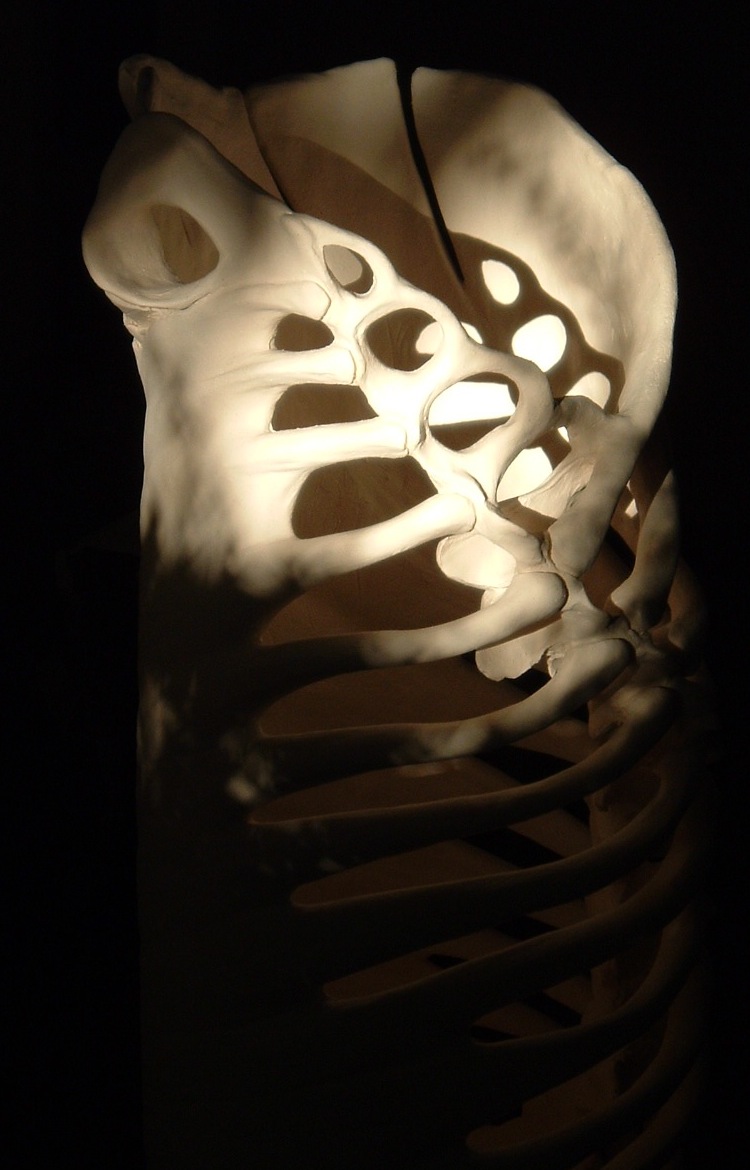
During one muse-filled summer break from teaching geology, a series of ceramic sculptures, whose central theme of twisted spinal columns sprang to life beneath my hands, telling tales of my own origins, my vertebrate ancestry. My own bones.
Cylinder Series, #1-22, after the bisque Summer 2004Detail, Cylinder Series, #19 Mary C Simmons
Our evolutionary paths cross, clay and I, in a moment of geologic time-the instant in which I so briefly live. I witness a distant past and participate in this miraculous path of life upon which my hands and this clay chanced to meet.
I can easily lose myself in Earth’s landscapes, especially the rocky ones. The textures and colors tell a story of chemistry, weathering and erosion. And, if providing a scenic backdrop to my life is not enough, with these rocks I make pottery and glazes.
And paint.
The color palette is generally limited to oxides of iron: brown, reddish-brown, tan, yellowish tan, greenish tan–e.g. Earth colors.
Occasionally a little copper shows up, coloring the clay softly green or blue. Pottery glaze colors depend on these denizens of the Periodic Table. And so did paint, once upon a time before IKB.
I started with several gallon-size zip-lock bags of reddish, greenish and one highly yellow clay. The colors are the result of a certain degree of iron oxidation, and finely ground turquoise, which is a copper mineral.
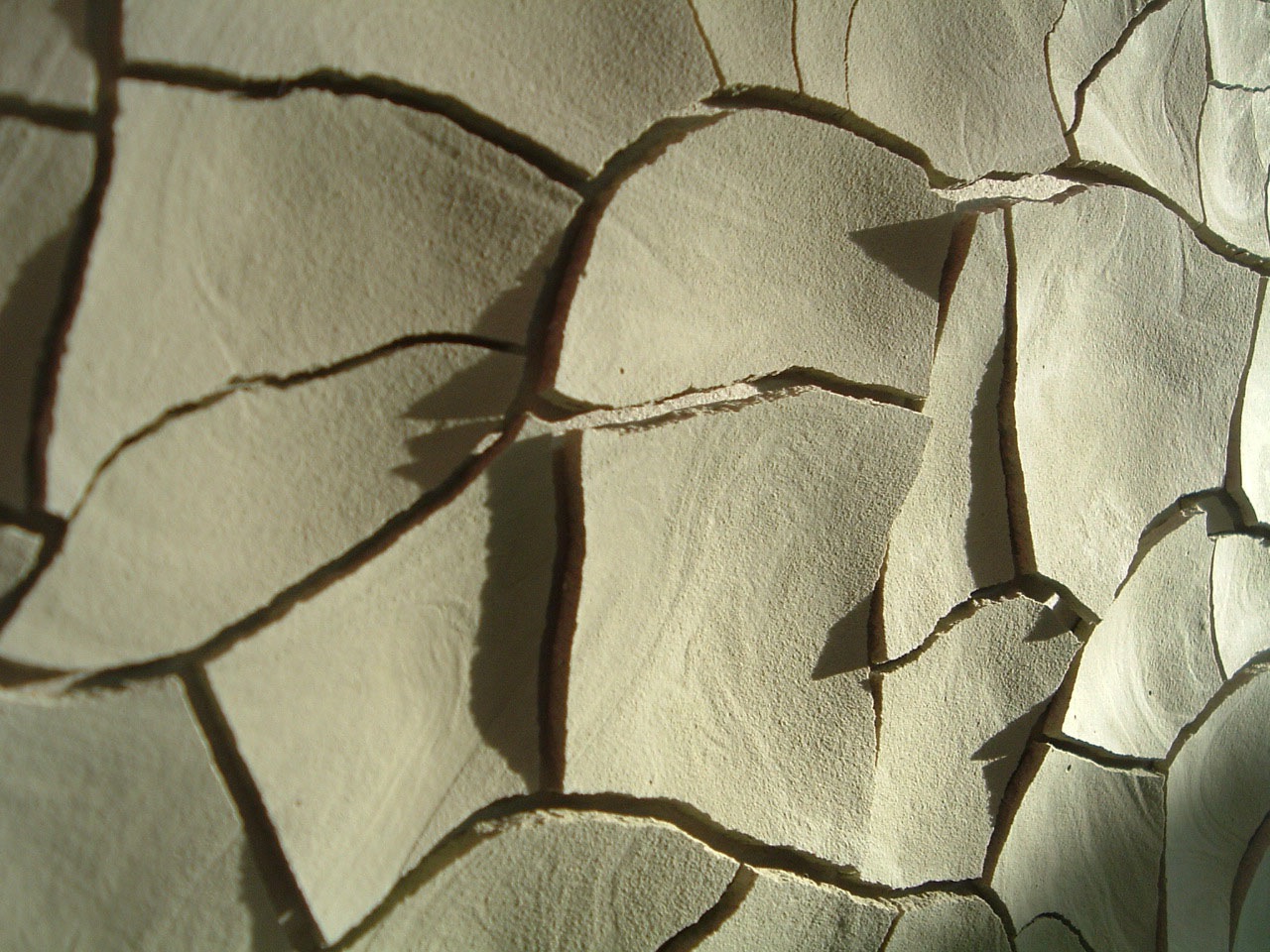
I sifted out all the rocks, twigs, animal bones and other detritus, and let the colored clay settle in large jars of water. After siphoning off the excess water, I poured this clay slurry onto large pieces of gypsum board to dry. The mud cracks were amazing art pieces in themselves.
Painting with Clay
After the clay slurry completely dried, I crushed and sieved each into a fine powder. I added a little linseed oil to the colored clay powder and in a frenzy of inspiration, I painted
The Paintings
What else can I say? Inspired by rocks, enchanted by Earth’s landscape…
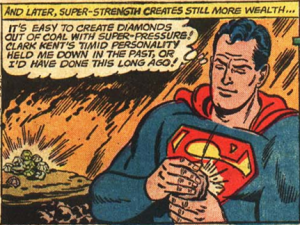
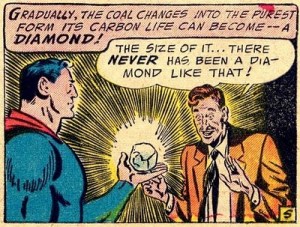
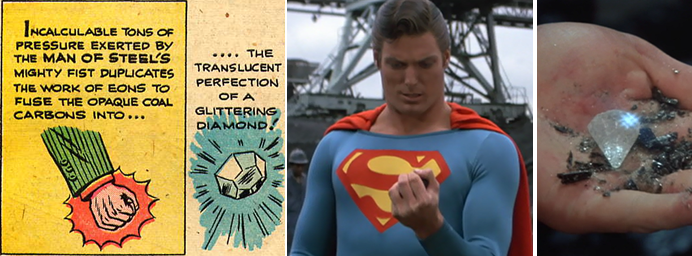
There we were, innocent boomer (and beyond) children looking up to Superman, gobsmacked by his prowess and great strength. Really? You can do that, Superman? Squeeze a lump of coalinto diamond? Not just once did we witness this feat, but time after time.
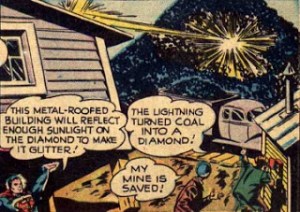
Perhaps somewhere along the way, a geologist sat Superman down and explained to him the facts of diamond formation, and how you theoretically could take a lump of coal and, given enough squeezing, make a diamond. But only if you add a lot of heat.
That would explain why Superman started using lightning to make diamonds.
Where’s the Super Squeeze?
Really little bolts, though. Hand-held, pocket-size lightning.
Lightning is very, very hot, along the order of 54,000°F, about 5 times the temperature of the surface of the sun.
But, heat alone can’t turn coal into diamond and lightning strikes at coal mines are far more likely to catch the coal layer on fire than to make a single diamond.
Superman Gets with the Program
Am I being too persnickety here?
Perhaps I expect my Superheroes to be omniscient as well. Or at least geologically literate. But is this fair?
In my own defense, it is not impossible for crows and humans to communicate (see Language of the Crows), and I offer a scientific, gene-based explanation for this ability.
Fantasy fiction takes us away on the gift of tongues, illuminating the path into the darkness of the silent unknown, tantalizing us with magical journeys that reveal the secrets of our universe. Hopefully we have the ears to hear and the eyes to see.
I’m glad Superman saw the light, keeping his Superhero image intact in the eyes of geologists everywhere. In the late 20th Century, however, when cartoon characters leaped from the printed page onto the big screen, it seems that Superman lost a little know-how in the diamond department.
Where’s the Heat. Man of Steel?
Alas, that Superman’s memory is less legendary than his great strength. What the cartoon knew, the “real” human did not.
That the truth of diamonds ever made it into a comic book is astonishing, however, and cause for a moment of gratefulness.
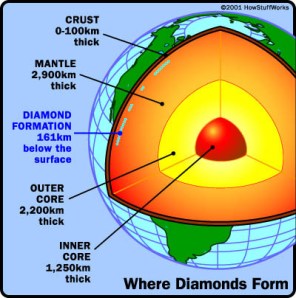
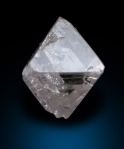
Diamonds form at the base of Earth’s crust, where pressure and temperature are very great. When pressure exceeds rock strength, an intense, but short-lived volcanic eruption occurs, and molten mantle rocks are shot to the surface through kimberlite pipes at the speed of sound.
That’s 768 miles per hour!
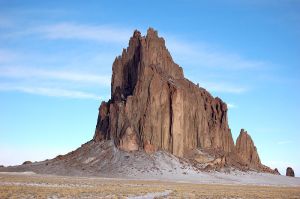
Kimberlite PipeShiprock, northwestern New Mexico
Kimberlite pipes bring up other minerals as well, like garnets, mined for use in sandpaper products. The Navajo Volcanic Fieldin the Four Corners area of the Southwestern US (not to be confused with Monument Valley), a few diatremes (the eroded remains of a kimberlite pipes) poke up out of the desert floor, Shiprock being the most well known.
Unlearning a ‘fact’ is harder than diamonds sometimes. Superman burned an urban myth into our 21st century collective memories at an early age that to this very day most of us still carry with us.
It’s not a matter of geological correctness. It’s a matter of the truth being so much more marvelous.
 Bones of Metal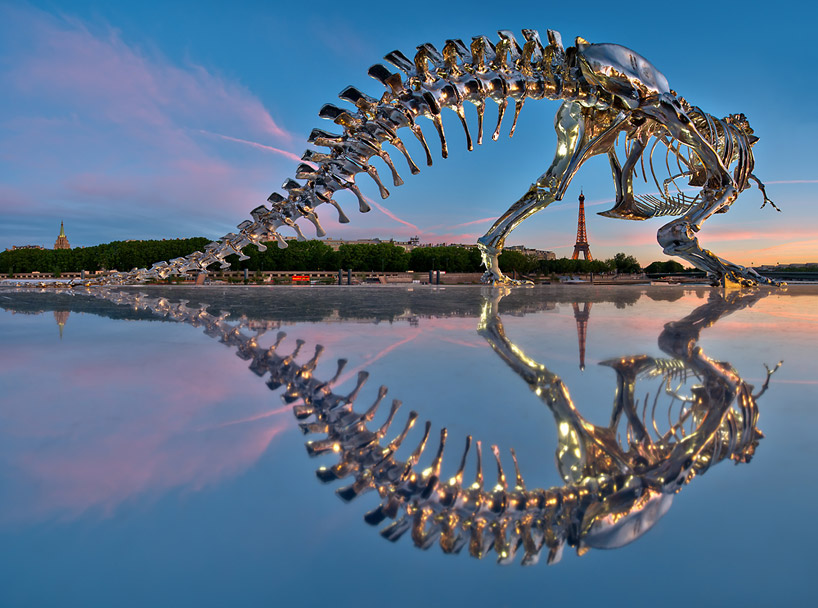

 Bones of Clay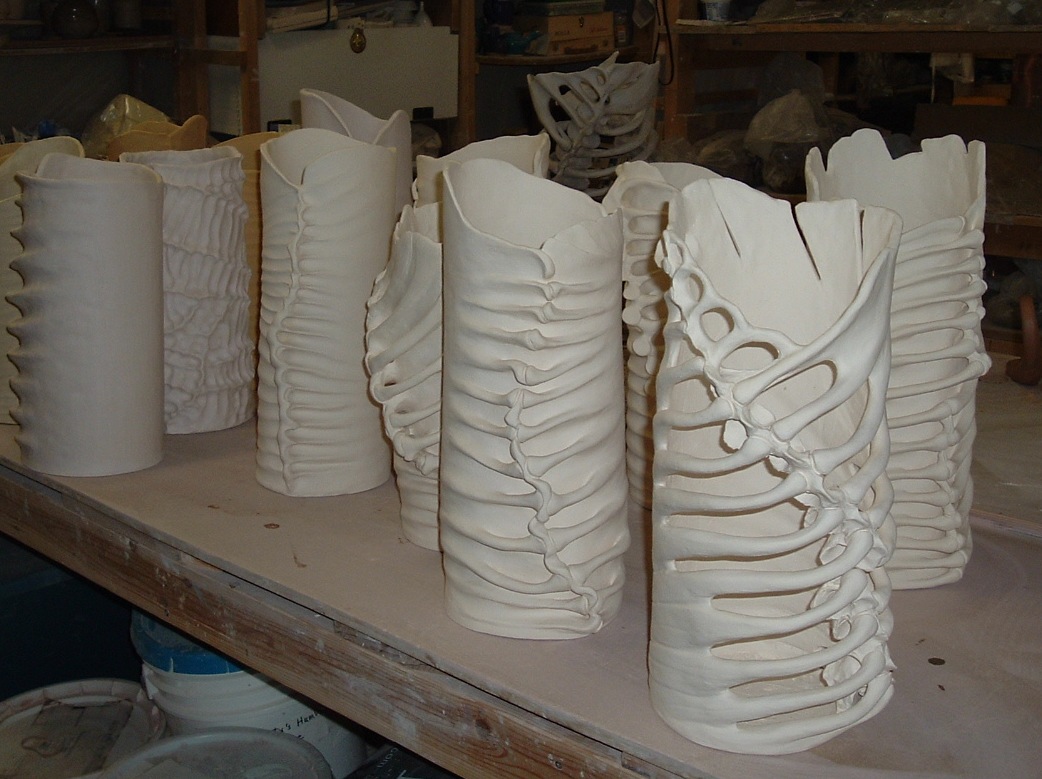







 Mary C Simmons
You must be logged in to post a comment.