About me…

Mother Love? Or Pavlov?

mum_baby_729-420x0Eau de Baby

Evidently baby body odor fires up the dopamine pathways in the female brain like hitting the jackpot at the slots, doing cocaine, or eating when you’re hungry. Researchers suggest that Eau de Baby evokes specific brain activity in women—the same brain centers that reward-inducing behavior activates, in order to promote mother-infant bonding (read article here…).

Not surprising, the dopamine pathways in women who had recently given birth showed increased activity than women who never had. Body odors, the researchers say, may lie at the core of ‘pyschobiological processes’—those that make us humans emotionally bond to one another for the sake of survival.

Surely this cannot be limited to the mother-infant relationship. Surely, in the economy of Nature, we would all bond to one another through our noses.

Meanwhile, a goal of much of modern chemistry is to eliminate or disguise the natural odors of the human body. What, I wonder, are the unintended consequences of that? Does blocking or disguising our natural body odors lead to inability to emotionally bond with others of our species?

Is that how someone gets so cut off from his own human family, that he could go into a crowded movie theater and in the dark, gun down 12 people he didn’t know?


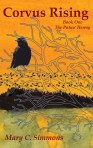
Charlie and Charlotte – Excerpt from Corvus Rising

 
fc5a3f4dd4439aa19a0f15b353773ddeCharlie the Blue-eyed Crow: the story of Charlotte…


Tell me about your friend, Charlie,” Alfredo said. “I would like to know another Patua’.”


Charlotte disappeared one day when she was seventeen,” Charlie began his story. “I hadn’t seen her in a few months. Rika and I had our first clutch that year, and I was in Keeper training, and just couldn’t get away. But the magpies all said that men in white coats drove up in a big van and took her away. She was crying, they said, when the white coats put her in a tiny shirt with really long sleeves that they wound all around her.

She kept screaming. All the way down the road, they could hear her screaming. The white coats took her to Rosencranz. That’s what the magpies told me.

I winged it over to Rosencranz, but couldn’t get in, of course; what hospital would let a crow in, even during visiting hours? So I visited every windowsill, looking for her. I peeked and sometimes downright stared into every window, more than once. For two years, I came and pecked on her window nearly every day.”

I admire your devotion, Charlie,” Jayzu said. “I cannot imagine.

Then one day,” the crow continued, “there she was! Just on the other side of the glass, sitting in a wheelchair with her hands folded neatly in her lap. But she did not see me.

I pecked on the window, but she did not hear me. I called out her name. ‘Charlotte! Yo! Charlotte! It’s me! Charlie!’ But she didn’t look up. She just stared at her lap, and I wondered if she had gone deaf.

I kept yelling and dancing and pecking, anything to get her attention. She didn’t hear me, didn’t see me.

I didn’t give up, though. Day after day, I showed up on the windowsill at the same time, trying to get her attention. But day after day, she didn’t look up. Until she did! She finally noticed me through the glass! I nearly fell off the windowsill.

“‘Charlie!’ she said, with the big smile I remembered from long ago. Of course I couldn’t hear her; the window was closed. Then she ran across the room and pasted both hands on the glass, as if to embrace me. I flapped my wings and cried out, ‘Charlotte! Charlotte!’ Great Orb, that was a wonderful day!

Then a white coat came up to Charlotte and took her hands off the window, giving each one a little slap and then escorted her back to her wheelchair.

“‘Charlotte!’ I yelled as he wheeled her out of the room. I pecked on the glass. I shouted as loud as I could. Another white coat came to the window, opened it, and yelled ‘Darn crows!’ as she tried to smack me with a towel.

She missed. ‘Darn humans!’ I yelled back at her.

Though I waited at the window, Charlotte didn’t come back that day. Or the next. I hung around, waiting and hoping for some sign of her. Days went by. I visited all the other windowsills again and again. Just as I was about to give up, there she was!

I pecked at the glass, and when she looked up, I flapped my wings at her. But she didn’t get up, didn’t smile at me, or say my name. I thought maybe she hadn’t really seen me. But when no one was looking, she smiled at me. She wouldn’t come to the window, though. Probably she was afraid they would slap her hands again. She never took her eyes off me until someone came and took her out of the room.

That was eight years ago. I see her often, but through a closed window. I can’t talk to her or hear her voice. But at least I can see her.”

Charlie ended his story; crow and human sat without speaking for several minutes. The pulsating song of crickets emanated from hidden places in the grass. Several loons wandered along the bank below, pecking for tidbits between the rocks and grass. A few gulls orbited a fishing vessel on the river.

I do not know what to say, Charlie, my friend,” Jayzu said at last. “I am sad for your friend, being locked away like that. Surely her family visits?”

Charlotte is alone, Jayzu,” Charlie said. “No one visits. No one can understand her. But I am telling you, Jayzu, she is as sane as you or I.”
 

CorvusRisingCover2

Read synopsis here….

Corvus Rising is now available at the Amazon Kindle Store…click here…

eBOOK GIVEAWAY!!!

-for a limited time (thru February 9), download a FREE Kindle version. Click <here>

Don’t have a Kindle? Click <here> for free app for your computer, iPad, tablet, smartphone…

Leanne McIntosh: Ecofantasy of Memory

squareknot01Earth, sole witness to our entire history, remembers everything in ways we cannot fully appreciate. The Celts considered trees as sacred entities, recognizing them as repositories of memory, lore and spirit-beings. The memory of all species is necessary to recall, to revive all that is lost.

I reflected on these things when my long-time friend, Jack, was diagnosed with Alzheimer’s disease. I took up his forgetting as an invitation from Earth into my own forgetting and began to write a Japanese form of poetry called haibun, which is a combination of prose and haiku poetry.

In these poems, excerpted from winter heart, the prose expresses my observations of a person with Alzheimer’s disease, followed by a pause before imagination leaps across the white space to the haiku, creating and exposing the disarray in the structure and functioning of the planet.

~~~

winter heart

Diagnosis and a scream gathers then flings itself into the public sphere. Fear runs through cobbled streets. There is no signpost for belief because without being told I know the future.

nothing foreseen
but the glacier dead ahead
melting

Shadows refuse to leave. Questions repeat. Post-it notes instruct the china cupboard. Another man’s shoes worn home seek privacy in a dresser drawer. I have no plan for a riddled memory and the last syllables, closest to the heart, are difficult to speak.

axe and saw
what do we tell the trees
before we cut them

Each time we meet it’s as though I’ve travelled a great distance and my arrival is a surprise, a treat, a joyful event. Some days my presence is a gift. Why would I want to be anywhere else?

eco-tourists
follow sea turtle hatchlings
cycle renewed

He regularly misreads the time, but it’s spring and the country has adjusted its clocks so taking his arm I move his wristwatch forward.

vanishing frogs
no sound in the pond—
never too late

He’s happy to see me, gives me a book, the newspaper, pictures from his pocket. We go to his room and he shows me the lamp he thinks he designed and turns the switch the way a village lights porch lamps to guide fishermen lost at sea.

sunlight
on the backs of salmon
an oilfield burning

Thirty years rush through my mind. Memories crowd blood rafters pressed against the forehead. A madness the heart clutches. The whole world a diminished dream and I wonder why the earth isn’t covered with tears.

along mountain roads
on Vancouver Island not
one wolverine left

~~~

Leanne McIntosh lives in Nanaimo, British Columbia. Her newest work, Dark Matter, is available from Leaf Press. Earlier books include Liminal Space (2003), and The Sound the Sun Makes (2004).

Arbutus menziesii in winter
Also known as Madrone, the Arbutus loses its leaves and the bark peels in summer. In winter the leaves are dark green lit with rain and the peeled portions of the tree brighten the grey skies.

Guest Posts Welcome!

Feather Please share your visions, musings, observations, prose, poetry…together we envision the Earth to come– remembering what was, acknowledging the moment that is…

Please contact me at kyanitequeen@gmail.com