Bread of Life, Bread of Art

DSCN6431

Tis the Season!

…for bread baking.
And time for another short course on Sourdough Bread Baking at the Creamery Arts Center in Hotchkiss, Colorado. Each of will us feed a cup of hungry microbes—a.k.a. Sourdough Starter, while I ply you all with buttered slices of this freshly baked at the Creamery, slathered with a local jam, all the while regaling you with True Microbe Stories.

And, how to make and bake it.

Artisan Bread

That’s what they call it now, the bread of our ancestors. It’s a very simple recipe: flour, starter, water and a little salt. This is bread you can live on. A form of lactic acid fermentation (think: yogurt, kefir, sauerkraut, kimchee…) sourdough starters ferment the grain in the dough, usually wheat, into more digestible food for us, and *BONUS* food for the good microbes that inhabit our guts and keep us healthy.

And, sourdough starters generate their own yeast, so you don’t have to add any. None. Zip. Nada. But you do need to let the dough rise for a much longer time than is needed for breads that use store-bought yeast. Eighteen hours is good. But sometimes the dough rises faster than that, so you just gotta bake it.

The granulated yeast in the packets and brown jars at the grocery store makes a passable bread–totally tastier than the mass-produced breads from commercial bakeries. But it is not as fabulous, nor is it evidently as nutritious to the human body as the wild yeast breads, aka those produced with sourdough starters.

As it turns out, sourdough starters are a microbial mixture of lactic-acid and alcoholic fermentation. Yeast microbes are alcohol fermentaters, and we need them to make the bread rise. Yeasty breads smell heavenly in the baking, but without the lactic acid fermentaters, the bread falls short in flavor. I’ll never go back to commercial yeast.

For the DIYers:

You can easily grow a starter yourself, comprising yeast microbes, which cause the bread to rise, along with three or so others that make the aforementioned very tasty bread. For more info on how to start and feed a starter (it’s easy, really!), go here: http://www.scientificpsychic.com/alpha/food/sourdough-bread.html.

Check out the link at the end about lactic acid fermentation, and Who’s Who in your starter, and what they eat, how they eat it. The beasties: yeast and lactobacillus…remember the fad some years ago, where Sweet Acidophilus Milk was readily available at major grocery stores? It was a good idea. A great idea.

Wonder why they stopped.

Lacotbacilli are not just good, not just great, they are essential to our health.


figure-1“Life without Lactobacilli is unimaginable”

Lactobacillus is a large family of rod-shaped microbes; several varieties reside in common foods we regularly eat, such as beer, wine, yogurt, sauerkraut, pickles, kimchi, and of course, CHOCOLATE! It’s the Lactobacillus sanfransiscus, the First Citizen of sourdough starters, that makes the bread fantastic. Yep, named after the famed Sourdough Bread of San Fransisco.

Mmmmm….microbes….how lucky we are to have them in our midst.

I love the microbes in my starter. I can’t see them, but I see evidence of them. The starter almost doubles in volume soon after feeding, as the microbes discharge CO2 while mawing down on the grain and sugars. I hear the CO2 bubbles snap and crackle as they pop. It makes me smile.

My little pretties.

BreadBowl3
Sourdough Bread Bowl with Winter Squash Soup

Crows—Inspiring Painters for 15,000 years

I love crows. They inspired me to write a fictional book about them. In doing so, I learned that they are smarter than our species gives them credit for. A lot smarter. They plan dream, love, raise new generations. And they notice us.

But they don’t make art. We do. And we make a lot of it about them.

Though some fear and loathe crows, many of us honor and revere them as intelligent, sentient, creatures; to some of us crows are a source of inspiration. Stroll through my Gallery of Crow Art in its many forms, from famous as well as unknown artists, poets, and writers, living and dead.

Paleolithic Cave Art

Lascaux-Broken
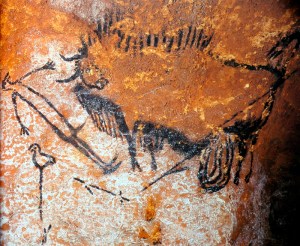
Paleolithic Cave Painting—Lascaux, France
Unknown Artists ~15, 300 B.C.E.

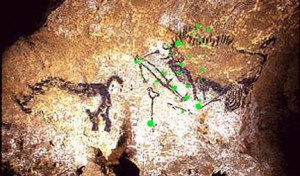
My interpretation of this cave painting: a crow on a perch overlooks a fatal encounter between a human and a big beast. Gored by a spear from this upstart Tool-maker, the beast prepares to impale the naked, hairless human on his horns, while his guts pour out onto the Earth. The crow is waiting for dinner. If it’s not about the Food Chain, it’s just not that important.

Or is it? Many believe the Lascaux cave paintings are star maps of Gemini, Orion, Taurus and Sirius.

lascaux_stars
http://www.timothystephany.com/stone.html

Wheatfield with Crows, Vincent van Gogh, July 1890

800px-A_Vincent_Van_GoghArt historians believe Wheatfield with Crows-painted just weeks before his death-was van Gogh’s last work.

 “Crows interest themselves in everything, and observe everything. The ancients, who lived far more completely than ourselves in and with nature, found it no small profit to follow, in a hundred obscure things where human experience as yet affords no light, the directions of so prudent and sage a bird.”—Jules Michelet, a favorite author of Van Gogh

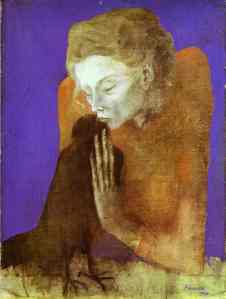
Woman with Crow, Pablo Picasso, 1904

33

Picasso painted Woman with Crow during his Blue Period, at about the same time he moved to Paris. The portrait features Marguerite Luc, whom he knew as Margot kissing and caressing a crow. Margot was the step-daughter of a cafe Picasso frequented.

Georgia O’Keeffe, painted crows too. More than once. She painted Canyon with Crows during the time she lived in Texas and depicts Palo Duro Canyon, whose Permian-aged iron-rich ‘red beds’ became the focal point of the painting. Just before your eyes jump to the crows flying in freedom above the red rocks.

georgia-o-keefee-paintings-canyon-with-crows-1917
Canyon with Crows, Georgia O’Keeffe, 1917

After O’Keeffe returned to New York, she painted Lake George with Crows.

karlins3-25-1
Lake George with Crows, Georgia O’Keeffe, 1921


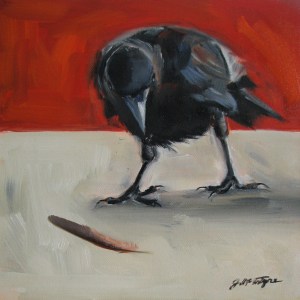
Oil paint, real feather. Wish it were mine.

IMG_0042
Crow Painting (Is it Mine?), Jacqueline McIntyre, 2010

The crow is in the painting, the feather is on our side of the canvas. That’s how my imagination works too. Crows step back and forth between it and the world of physical reality. I find their feathers everywhere…
Another unabashed crow-lover:

Crow2
Two Crows, Kristin Fouquet, 2010

Kristin Fouquet’s photograph, Two Crows, graces the cover of Full of Crow – “an independent online literary magazine that publishes poetry, fiction, flash, reviews, interviews, articles, art, photography, and more…”

I could go on. And on and on and on….about the ways and means that crows have inspired our species.  But do go ahead and continue looking…Google ‘crow art’ – 62,400,000 hits.

Landscape Paint and the Chemistry Blues

419px-Johannes_Vermeer_(1632-1675)_-_The_Girl_With_The_Pearl_Earring_(1665)Alchemy reigned at the time Johannes Vermeer painted Girl with a Pearl Earring in 1665. Back in that day, before the Periodic Table of the Elementswhich didn’t show up in until 1869—painters made their own paints from the powders of ground minerals by mixing them with linseed oil.

lapis-lazuli-rough
Lapis lazuli

The pigment in the blue scarf around the head of the Girl with a Pearl Earring, for instance, was made from lapis lazuli, a beautiful but rather expensive mineral to be grinding to a powder.  Unfortunately, linseed oil made the fabulous blue color of this beautiful mineral a bit cloudy.

Linseed oil did that to most of the mineral powders, but there was no way around that in 1665. The mineral powders would be chalky-looking and would not flow onto the canvas smoothly without being mixed with linseed oil.

Better Living Through Chemistry

The Periodic Table going public in 1869 moved the job of creating paint from artists to the laboratory chemist. These days, few artists mix their own paints, or even know what’s in them. I’m a big fan of chemistry, for without it, there is nothing. No rocks, no clay, no paint. And I wonder how they make vivid yellow as well as intense red paint from the same thing. Not a mineral, but an element from the Periodic Table: Cadmium.

Modern painters can thank French artist, Yves Klein and a few French chemists, who created a rich luscious blue paint that retained the brilliant blue hue by suspension of the dry pigment in a synthetic resin, avoiding the murkiness of linseed oil.

They called it International Klein Blue. Yves Klein used IKB, as this patented pigment is known, to paint Blue Monochrome, part of a series of one-color paintings he had been creating for several years.

BlueMonochrome
Blue Monochrome, Yves Klein, 1961

IKB represented something profound to Klein: le Vide-the Void. Not a vacuum or terrifying darkness, but a void that invokes positive sensations of openness and liberty, a feeling of profound fulfillment beyond the everyday material world. Standing before Klein’s huge canvases of solid blue, many report being enveloped by serene, trance-like feelings.

That’s how the Southwestern desert landscape makes me feel.

the-surreal-rock-formations-were-created-over-thousands-of-years-as-water-and-wind-eroded-the-navajo-sandstone

The iron-stained colors of my native land inspired me to make paint from it, in the old way—grinding the minerals to a powder and mixing them with linseed oil. Perhaps because these paints are made from desert clays (see my previous blog Desert Paintings), linseed oil did not make them murky.

35321_1346473504741_6813196_n
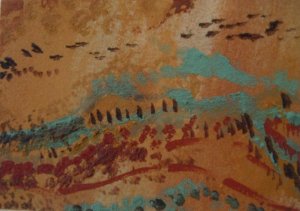
Crows Across the Sky, Mary C. Simmons, 2010