The Ants Go Marching…and marching…and marching

…until death do they part.
………………………………………………………………………………………………………………………………………………………….

Ants-300x240Us and Them

Ever since I wrote Corvus Rising, I’ve considered in great depth and detail how the other living beings on Earth are more like us than not. We humans are fond of viewing our species at the top of the evolutionary ladder that we invented to explain the differences in anatomy and intelligence between Us and Them.

Our species is evidently highly favored: the very Deity we invented created Us to have dominion over Them.

More and more, however, it is apparent that our world view of creation is all wrong.

In the case of the corvidae (crows, ravens, magpies, jays…) we now know that their brains are very nearly the same size as ours (proportional to their bodies) and that they are not only intelligent, but sentient as well. (The Gifts of the Crow, Mazluff, 2012)

And we know that they talk to each other, as shown by Michael Westerfield’s marvelous book, The Language of Crows, whose recordings of crows and ravens dialogs in a variety of situations tells us their speech is not just about looking for a mate to make little corvids with.

Then there’s that little pufferfish, whose connection to the Universe I share. Blows me away. We are all hooked into the same life-giving forces, by whatever deity you or I wish to call it. I like to call it Art.

Them Ants…

Ants are pretty cool; among my favorite books as a child was The City Under the Back Steps—a marvelous story of a couple of kids who magically get shrunk down to ant size.
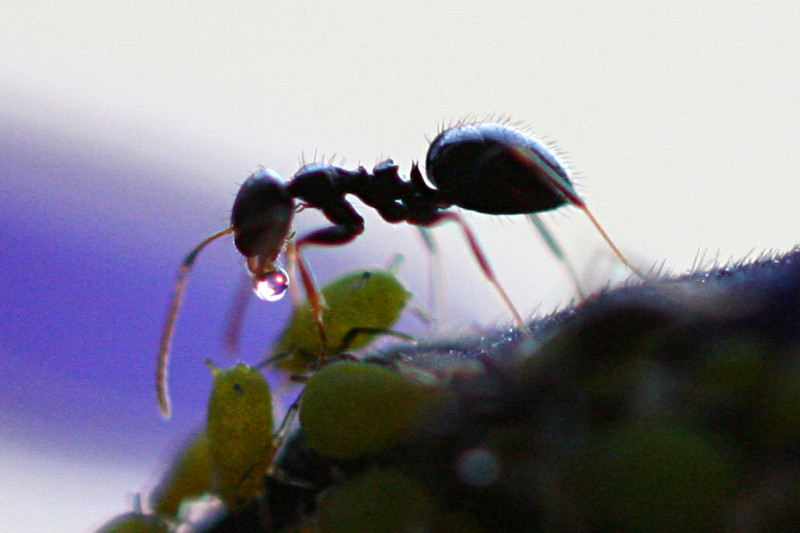
Ant_Receives_Honeydew_from_AphidThe children are shown all around the colony by the ants, and were instructed (as I was) in many of the ways of all ants. For instance: the ants kept herds of aphids and milked them for the sugars the little buggers sucked out of the rosebush. They really do that.  (Read more about how ants milk aphids here…)

Natural science from a fictional children’s book: a marvelous way to learn.

I am a fan of ants, more or less. As long as they don’t invade my house or sting me.

I watched nervously one summer as a gigantic ant colony constructed a subterranean civilization around the size of Denver in my backyard.
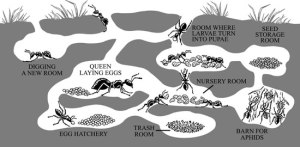
Ant-Farm
Click image for more info about ants & ant colonies

The problem with a humongous ant colony in my back yard: their sheer numbers so close to where I live.  They kept opening up exits and entrances all over the place, including right next to the porch and back steps. Made me nervous.

These are the kind of ants with the big jaws on their heads connected a sack of poison on the other end that is at least a third the size of their whole bodies.
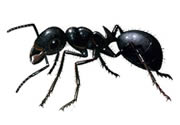
garden_ant_180_tcm9-60508
Black Garden Ant.

Ant bites are bad news. Painful bad news. Every time one injects me with its personal stash of formic acid, it’s worse than the time before. So I am looking a little askance at the city under my back steps. I don’t want them there, but there they are.

And I am outnumbered. Pathetically outnumbered.

My father used to pour gasoline down ant holes and light it. Horrifying. So are pesticides. I do believe the ants have a right to be alive and pursue their ant-like goals. Just not so close to my soft, living flesh.

I didn’t want to kill them. I just wanted them to move. So I flooded them out with the garden hose, a slow trickle of water that filled up the vast network of caverns and passageways. Ants do not have lungs, I reasoned, therefore cannot drown.
But they do float well.
Jillions of ants floated up and out; most found things to cling to and rode the current to edge of dry land where they disembarked.

As soon as I turned off the water, the ants went to work re-building what I had ruined. The next day, I filled the ant hole up again, and ants bubbled up again. When the flood stopped, the ants started building again. I marveled that none of them went belly up on the sidelines, waving their six little legs in the air, otherwise whining and bellyaching about unfair the universe is, or how hard their lives are.

We do that. The animals don’t. They get over it and get on with living.sad-bug-with-napsack-smaller
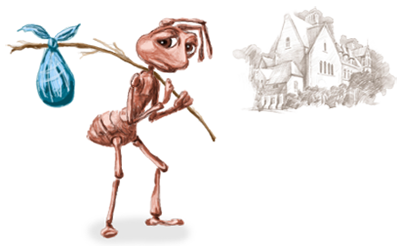
Why can’t we?

The end of the ant story: I kept watering the ant hole and they kept rebuilding. I admired the hell of them. No complaining, no retaliation. Just one foot in front of the other five, and with a pebble in each jaw, they rebuilt.

And I kept destroying. We went on like this for days, me alternately admiring them and destroying them; the ants just kept rebuilding.

Persistence is Everything

They finally moved. They got sick of it, evidently, of spending all their time rebuilding their colony after the continued disaster I brought them. So they moved, lock stock and nursery to the alley behind the house.

Beyond the reach of my hose…

615645dcfad8ce6a1f0e885b6d4ed1fb

Angry Crows … Book excerpt

Respecting the Earth and All Its Inhabitants (Book Excerpt)

Cover

Excerpt from Corvus Rising, by author, geologist, and artist, Mary C Simmons.

Written from the perspective of a group of intelligent crows and ravens, the Corvids, Corvus Rising sheds light on the environmental destruction taking place in our world in the name of progress, economic development, jobs and greed.

Simmons wants readers to realize the importance of preserving and respecting nature and the environment.  “Corvus Rising presents the issues humorously with a suggestion that just maybe one day animals will get fed up enough to fight back.” —Editor Post, Living Green Magazine

Alfredo picked up his mic, leaving his partially eaten lunch on the table. “Why do we need wilderness at all?” he said to the crowd. “I would like to answer that with a quote from Edward Abbey, noted author and outspoken defender of wilderness.”

He pulled a small notebook out of his shirt pocket and read: “‘The love of wilderness is more than a hunger for what is always beyond reach; it is also an expression of loyalty to the Earth, the Earth which bore us and sustains us, the only paradise we shall ever know, the only paradise we ever need, if only we had the eyes to see.’”

A few people clapped. Alfredo smiled as he closed the notebook and put it back in his pocket.

“Too bad most of us will never see it!” a man in the back shouted.

“Somewhere along the way,” Alfredo said, ignoring the heckler, “we gave ourselves dominion over the Earth, which has all but severed our connection to the web of life. We built great cities, where we concentrated power and wealth, while we impoverished our spirits and our wild lands…”

CorvusRisingCover2The crowd had grown. A few crows collected in the trees surrounding the bandstand, staring down at Alfredo. Or was it his lunch?

“Cities weigh heavily on the hearts of men and women,” he continued, “and we must be able to escape them, even if it is just in our imaginations. In wilderness, we find ourselves. As we cherish one of our last wild places, let us become aware of our connection to it and impose surrender upon ourselves.”

“Surrender?” the man at the back of the crowd shouted. “Never!”

”Yes,” Alfredo said, “Surrender. The old hermit, Brother Wilder, surrendered to the wilderness we are now trying to preserve. He chose this wild island as a refuge from the world of cities and men, and spent his life in solitary contemplation of the glory of creation.”

“Who has time for that?” the man in the back shouted.

“Some of us have to actually work for a living!” someone yelled.

Anger surged in Alfredo’s chest. “While most people do not desire such lengthy solitude, it is through these pristine and unaltered wild lands that our spirits connect us to the Earth. As we gaze upon our island from across the river, its wilderness lives within us all; let us not now throw it away for a few pieces of silver.”

The crowd cheered and many clapped. A small crow dropped from the sky onto the table, and beaked a noodle from Alfredo’s plate.

Alfredo turned off his mic and said, “Well, hello little fella!”

“Don’t you know me, Jayzu?” the crow said, looking up.

“Of course I know you!” Alfredo said in a very low voice. “Grawky, JoEd!” He smiled and put out his hand. JoEd brushed it with his wingtip.

“Grawky, Jayzu!”

Nine more crows dropped down to the table, all talking at once.


Mary Simmons is a geologist by education and an artist by avocation. Simmons holds a Masters in Science in geology, worked for the US Geological Survey, and has published several scientific papers. Based on her background and expertise in geology, Simmons has a deep interest in the preservation of wilderness and creatures in the face of human development of land. As for her creative side, Simmons enjoys writing, making pottery and jewelry, and painting. Simmons uses clay and ground up rocks from the local landscape to make potters clay and glazes. She currently resides on the Western Slope of the Rocky Mountains in Colorado. For more information on her book, Corvus Rising, please visit http://www.authormarycsimmons.com/

Source: http://livinggreenmag.com/2013/04/29/mother-nature/respecting-the-earth-and-all-its-inhabitants-book-excerpt/#U3MiyIMB9CPflWBQ.99

The Law is an Ass

abf0c16e325cd1f022ac3a46879258f4A look into some of the many faces of ‘the’ Law…

Man’s Law

That’s the kind of law which governs the Affordable Care Act, paying taxes, stopping at red lights, having to wait until you’re 21 to drink alcohol, as well as all the penalties accrued and assessed for violations.  Man’s Law  also includes a majority of  ‘God’s Laws’—those governing ethical behavior, e.g. the No Kill Law, the No Stealing Law—those things we all just sort of don’t do, as a rule, but just in case we forget, Moses brought the stone table down from the mountain and made it official.

Man’s Law, at least in the US, excludes any and all rules pertaining to False Gods, Swearing, Keeping Holy the Sabbath, and Honoring Your Parents. Oh, and Coveting—we do all get to covet with complete impunity.

Man’s Law governs and includes all judicial decisions. The way that Man’s Law is an Ass can be understood best in terms of a few recent US Supreme Court decisions, e.g.  Kelo v City of New London, 2005, which expanded ‘public good’ to include ‘tax revenue and jobs created by condemning and razing an old lady’s house and building a shopping center.’ Seriously. The government can condemn your property and sell it to a developer.

Citizen’s United v. Federal Election Commisson, 2010. Corporations were given personhood, and therefore the government is prohibited from restricting a corporation’s contribution to political candidates, parties, PACs. Representative government becomes government not of, by, or for the people, but for those with the most bucks. The Monarchy of Money. So much for democracy

Then there’s the Hobby Lobby decision. That’s the one where a company, and presumably a private individual as well, can use a deeply held belief in God’s Law to decide which one of Man’s Laws they don’t have to comply with.

I actually like that one—I can opt out of lots of things on those grounds. Taxes—ain’t gonna pay for war no more.

But, seriously, it’s a whole boxful of Pandoras (a famous saying by former NM Governor Bruce King) that we as a country of 300 million probably don’t really want to let out.

Render unto Caesar?

…that which is Caesar’s and unto God that which is God’s—so says a gospel of Matthew.

smoking+uncle_sam_taxes

And there you have it. Man’s Law is Caesar’s Law—Caesar of course being ‘the government.’ Therefore, the “Render unto Caesar’ rule must extend  to keeping its laws. Except when it’s a privately-held corporation with deeply held religious beliefs, and then God’s Law supercedes. Good thing we don’t think God wants us to stone women of other faiths to death, or fly airplanes into tall buildings.

What if obedience to Man’s Law (or God’s Law) causes or allows suffering of others to continue? Should one steal food to feed one’s hungry children or let them starve? Is this God’s will? Should hungry people get away with stealing food?

Deities can be spectacularly subtle

In my ecofantasy novel, Corvus Rising, the Jesuit priest, Alfredo Manzi, struggles with whether to obey Man’s Law and be considered righteous and without blame, or to commit a criminal act that will alleviate the suffering of another. He prays to God, asking for guidance. Does God want us to break laws? Alfredo wonders, but receives no answer.


CorvusRisingCover2“Deities can be spectacularly subtle,” Charlie the blue-eyed crow tells the priest. “That’s been the corvid observation of human gods in general over the years.”
“As well as spectacularly unhelpful,” Alfredo said as he drew the outline of the grounds of Rosencranz in the sand. “Sometimes God wants us to find our own way, I guess.”
“Well, it might help if you ask a yes or no question,” Charlie said. “Then the deity could catch a bush on fire, which would be a yes answer I would think. However, silence could also be construed as consent, albeit far less dramatic.”                      
-excerpt from Corvus Rising


In other words, sometimes we’re pretty much on our own.


horns-of-a-dilemma