Corvus Rising – Synopsis

Adobe Photoshop PDF

Corvus Rising is a fantasy tale told in part from the point of view of crows, about an extraordinary yet nearly extinct group of humans who speak their language, known from antiquity as “the Patua’ “. Together, humans, crows, ravens, and a multitude of other birds, unite and take a stand against the destruction of an enchanted island.

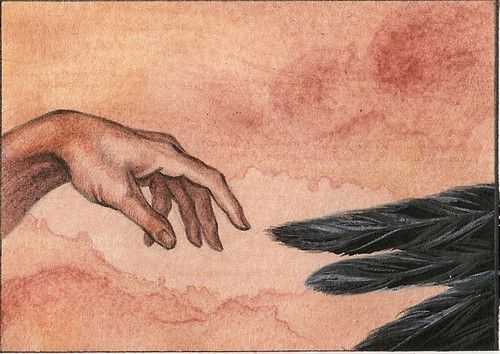
The story opens as Jade Matthews, a gifted painter with a vivid imagination, awakens from a nightmare in which a band of crows has broken into her bedroom through a large window. She fears that the crows are looking for her most treasured possession: a strange medallion given to her by the mother she never knew. The medallion seems ancient, carved from stone or a very hard wood, depicting a human hand and a bird wing clasped in friendship.

Jade’s husband Russ is a biology professor at the local university, as is the Jesuit priest and noted ornithologist, Alfredo Manzi. The priest serendipitously discovers the enchanted Wilder Island, home to an unusual population of blue-eyed crows and ravens. He meets Charlie, patriarch of the great Hozey clan–one of the many old families of crows on the island, known to them as Cadeña-l’jadia–land of misty marshes and green forests.

Manzi learns that he is not a freak, that there are others like him, others who speak Patua’. Charlie tells Manzi about his old friend Charlotte, trapped in an insane asylum for years because she does not speak human languages, though she is fluent in Patua’.

But there is more to the island than blue-eyed crows. Manzi discovers a rustic chapel built by the man for whom the island was named; an old hermit, coincidentally a Jesuit brother of the 1800’s named Maxmillian Wilder. The chapel completely charms Manzi, built from living trees and vines, with a roof that resembles an upside-down bird’s nest. He finds the old hermit’s bones in the chapel, and a strange medallion carved from a very hard wood or stone, with the image of an intertwined wing and a human hand.

Coincidentally, with Manzi’s discovery of Wilder Island, his superior, the Father Provincial of the North American Society of Jesus in Washington DC, learns that the Order owns the tiny uninhabited Wilder Island, located in the middle of one of America’s biggest rivers.

With the Father Superior’s blessing, Manzi makes the island his home, just in time to stave off the advances of the developer who plans to build a gambling resort on the island. Turned down by the Jesuits to purchase the property, the developer turns to a condemnation lawsuit under US eminent domain laws, recently expanded to allow for public use to include commercial development.

The threat to the island is dire. With the financial backing of the Father Superior, a tree-hugging attorney named Kate designs a land trust-the Friends of Wilder Island, to defend it and deflect the developer’s condemnation suit. Manzi invites his colleague Russ Matthews and his artist wife Jade, and his helper Sam Howard to join the land trust, and they name it Friends of Wilder Island.

Manzi risks exposing his strange ability to speak with crows to other humans–a secret he has kept hidden his entire life, as he tries to unite them against the destruction of a unique wilderness.

While the humans argue over the merits of wilderness preservation and economic development, Charlie the blue-eyed crow and the Great Corvid Council take matters into their own wings. Fanning out in all directions, the crows and ravens gather a multitude of birds of all feathers to take a stand and defend Cadeña-l’jadia, ancestral homeland to the great Hozey clan, and the beloved Bruthamax, the old Jesuit hermit who came to the island a century ago.

So… what’s a Corvus?

Say what?
Say what?

Short answer: crows and ravens are members of the genus Corvus.
Long answer: <click here…>

Oh, by the way…

Corvus Rising is available as a paperback, and at the Amazon Kindle Store. <right here>

Angry Crows … Book excerpt

Respecting the Earth and All Its Inhabitants (Book Excerpt)

Cover

Excerpt from Corvus Rising, by author, geologist, and artist, Mary C Simmons.

Written from the perspective of a group of intelligent crows and ravens, the Corvids, Corvus Rising sheds light on the environmental destruction taking place in our world in the name of progress, economic development, jobs and greed.

Simmons wants readers to realize the importance of preserving and respecting nature and the environment.  “Corvus Rising presents the issues humorously with a suggestion that just maybe one day animals will get fed up enough to fight back.” —Editor Post, Living Green Magazine

Alfredo picked up his mic, leaving his partially eaten lunch on the table. “Why do we need wilderness at all?” he said to the crowd. “I would like to answer that with a quote from Edward Abbey, noted author and outspoken defender of wilderness.”

He pulled a small notebook out of his shirt pocket and read: “‘The love of wilderness is more than a hunger for what is always beyond reach; it is also an expression of loyalty to the Earth, the Earth which bore us and sustains us, the only paradise we shall ever know, the only paradise we ever need, if only we had the eyes to see.’”

A few people clapped. Alfredo smiled as he closed the notebook and put it back in his pocket.

“Too bad most of us will never see it!” a man in the back shouted.

“Somewhere along the way,” Alfredo said, ignoring the heckler, “we gave ourselves dominion over the Earth, which has all but severed our connection to the web of life. We built great cities, where we concentrated power and wealth, while we impoverished our spirits and our wild lands…”

CorvusRisingCover2The crowd had grown. A few crows collected in the trees surrounding the bandstand, staring down at Alfredo. Or was it his lunch?

“Cities weigh heavily on the hearts of men and women,” he continued, “and we must be able to escape them, even if it is just in our imaginations. In wilderness, we find ourselves. As we cherish one of our last wild places, let us become aware of our connection to it and impose surrender upon ourselves.”

“Surrender?” the man at the back of the crowd shouted. “Never!”

”Yes,” Alfredo said, “Surrender. The old hermit, Brother Wilder, surrendered to the wilderness we are now trying to preserve. He chose this wild island as a refuge from the world of cities and men, and spent his life in solitary contemplation of the glory of creation.”

“Who has time for that?” the man in the back shouted.

“Some of us have to actually work for a living!” someone yelled.

Anger surged in Alfredo’s chest. “While most people do not desire such lengthy solitude, it is through these pristine and unaltered wild lands that our spirits connect us to the Earth. As we gaze upon our island from across the river, its wilderness lives within us all; let us not now throw it away for a few pieces of silver.”

The crowd cheered and many clapped. A small crow dropped from the sky onto the table, and beaked a noodle from Alfredo’s plate.

Alfredo turned off his mic and said, “Well, hello little fella!”

“Don’t you know me, Jayzu?” the crow said, looking up.

“Of course I know you!” Alfredo said in a very low voice. “Grawky, JoEd!” He smiled and put out his hand. JoEd brushed it with his wingtip.

“Grawky, Jayzu!”

Nine more crows dropped down to the table, all talking at once.


Mary Simmons is a geologist by education and an artist by avocation. Simmons holds a Masters in Science in geology, worked for the US Geological Survey, and has published several scientific papers. Based on her background and expertise in geology, Simmons has a deep interest in the preservation of wilderness and creatures in the face of human development of land. As for her creative side, Simmons enjoys writing, making pottery and jewelry, and painting. Simmons uses clay and ground up rocks from the local landscape to make potters clay and glazes. She currently resides on the Western Slope of the Rocky Mountains in Colorado. For more information on her book, Corvus Rising, please visit http://www.authormarycsimmons.com/

Source: http://livinggreenmag.com/2013/04/29/mother-nature/respecting-the-earth-and-all-its-inhabitants-book-excerpt/#U3MiyIMB9CPflWBQ.99

#WW #FF #WTF? Twitter Thoughts

As I explained it to my mother, Twitter is like a superhighway comprising an infinite number of lanes that head in all directions. Over a half billion cars travel this highway, and they’re all honking their horns at once, 24 hours/day 7 days a week.

I Tweet You Tweet We All Tweet

The noise is deafening. Relentless, continuous chattering–554,750,000 registered users spouting a half million tweets at the rate of 6- 9,o00/second. (Click here for more Twitter statistics….)

Every day.

#WW #FF

Whatever that means. There is general agreement among us Twits that the second W refers to Wednesday. But what of the first W? Some say it’s Wacky, some say it’s Wet, some say it’s Writer’s. Wicked Wednesday, maybe?

Friday it’ll be #FF. Fast Friday? Freaking Friday? Finally Friday? Oh, yeah..it’s FOLLOW FRIDAY!

#WTF?

Everyone knows what that means. But seriously, wtf?

Whether it be #WW, #FF #MM (Monday, Monday?) what does it all mean? Well, as I told it to my mother, #WW and #FF are days of Mutual Admiration, where we honor and mention each other for RT’ing, following, SO’s and etc. I might tweet: #WW @YouRock, @MinnieTheMoocher, @EroticPancreas, @Nauseum…thanks for the follow!

Some overachievers–and I have been one–will tweet several #WW’s, because there’s that 140 character limit and I have many Twits to thank. After the #WW posts, @YouRock, @MinnieTheMoocher, @EroticPancreas, @Nauseum all retweet it to all their followers, who may retweet it to all their followers.

No #WW, No Cry

I’m totally grateful for any mention or attention I get on Twitter; far be it from me to complain about that. But, the Twitter traffic generated from these retweeted #WW’s–which really don’t say anything at all beyond a list of @What’sHerNames–is about as interesting and productive as a real-life traffic jam at rush hour in Denver.

I have adopted a new method for dealing with #WW, #FF tweets. Mention me? Instead of retweeting the #WW with a whole slew of @WhoAreYou, I’ll try to retweet something meaningful about you–from your profile, your tweets.

Make it easy on me.

Don’t make me search page after page of your RTing of everyone else to find the one tweet about YOU. Don’t make me compose something from your mini-bio on your profile page–I have x amount of time to spend on Twitter–I am happy to promote you, your book, your art, your diet plan, or your donuts. It’s OK to mention something you are doing a couple times a day in the midst of RTing everyone else. We are all here promoting ourselves, after all. Make it easy on me.

This blog by Alicia Cowan (@Absolute Alicia) gives fabulous advice on the whole #FF thing “Simple Twitter Tips: What Does #FF Mean?”

And  let’s cut down on that meaningless #WW, #FF chatter, eh?