I’m fascinated by bones…all bones, especially the white bleached remains of the wild creatures picked clean of all flesh, marking the place where they lay down on the Earth and died.
I am not alone….
Bones of Metal
French artist Phillipe Pasqua designed and fabricated this full-scale, 21 foot tall Tyrannasauras rex sculpture. Comprising 350 bones of chrome and aluminum, the Lizard King towers over the Seine River in France.(Click here for more…)
Bones of Rock
Speaking of T-Rex, a rare nearly complete fossilized skeleton heads for the Smithsonian as the centerpiece for the new dinosaur hall. <more here…>
In other bones, Paleontologists recently excavated the fossilized tail of a 72-million year old hadrosaurin the northern desert of Mexico. Discovered by locals, the scientists unburied fifty remarkably well-preserved vertebrae. From these bones, scientists determined the dinosaur suffered from arthritis and tumors (Click here for more…)
Bones of Clay
From molten origins of Igneous rocks, whose feldsparsundergo weathering and disintegration at Earth surface, forming a variety of clay minerals that, thankfully, blanket much of Earth’s surface.
I too am descendent from Firstborn Earth. I know this clay. It is me.
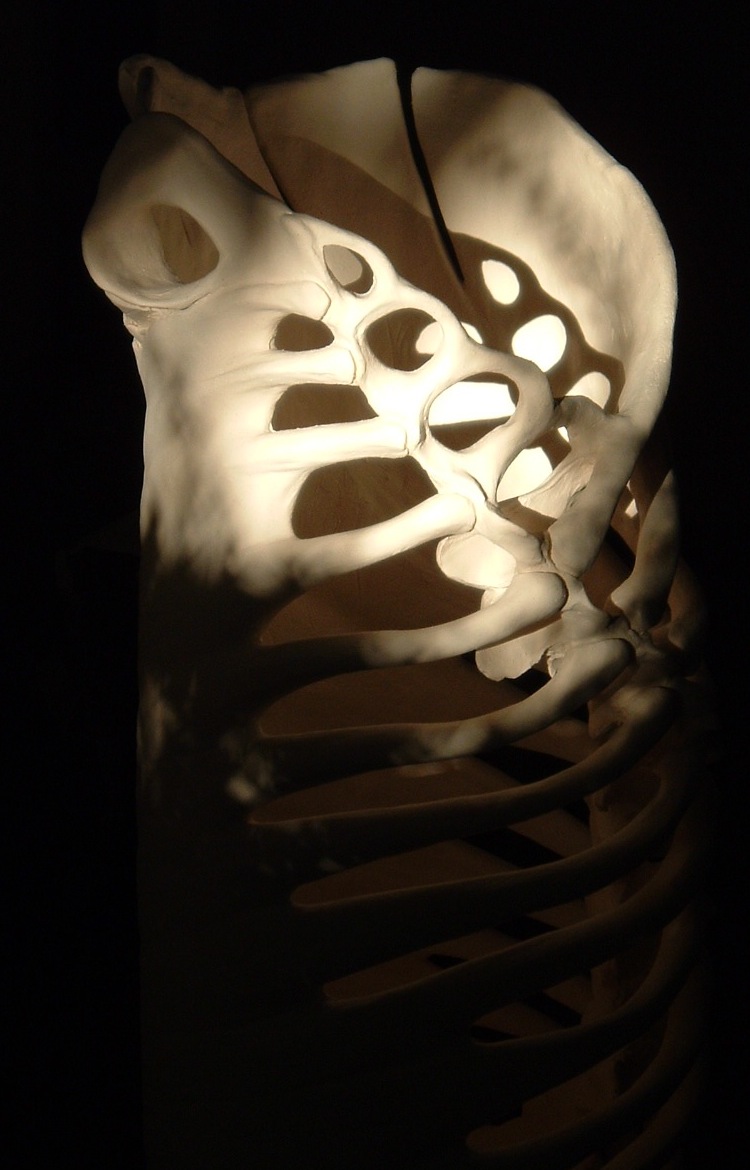
During one muse-filled summer break from teaching geology, a series of ceramic sculptures, whose central theme of twisted spinal columns sprang to life beneath my hands, telling tales of my own origins, my vertebrate ancestry. My own bones.
Cylinder Series, #1-22, after the bisque Summer 2004Detail, Cylinder Series, #19 Mary C Simmons
Our evolutionary paths cross, clay and I, in a moment of geologic time-the instant in which I so briefly live. I witness a distant past and participate in this miraculous path of life upon which my hands and this clay chanced to meet.
I can easily lose myself in Earth’s landscapes, especially the rocky ones. The textures and colors tell a story of chemistry, weathering and erosion. And, if providing a scenic backdrop to my life is not enough, with these rocks I make pottery and glazes.
And paint.
The color palette is generally limited to oxides of iron: brown, reddish-brown, tan, yellowish tan, greenish tan–e.g. Earth colors.
Occasionally a little copper shows up, coloring the clay softly green or blue. Pottery glaze colors depend on these denizens of the Periodic Table. And so did paint, once upon a time before IKB.
I started with several gallon-size zip-lock bags of reddish, greenish and one highly yellow clay. The colors are the result of a certain degree of iron oxidation, and finely ground turquoise, which is a copper mineral.
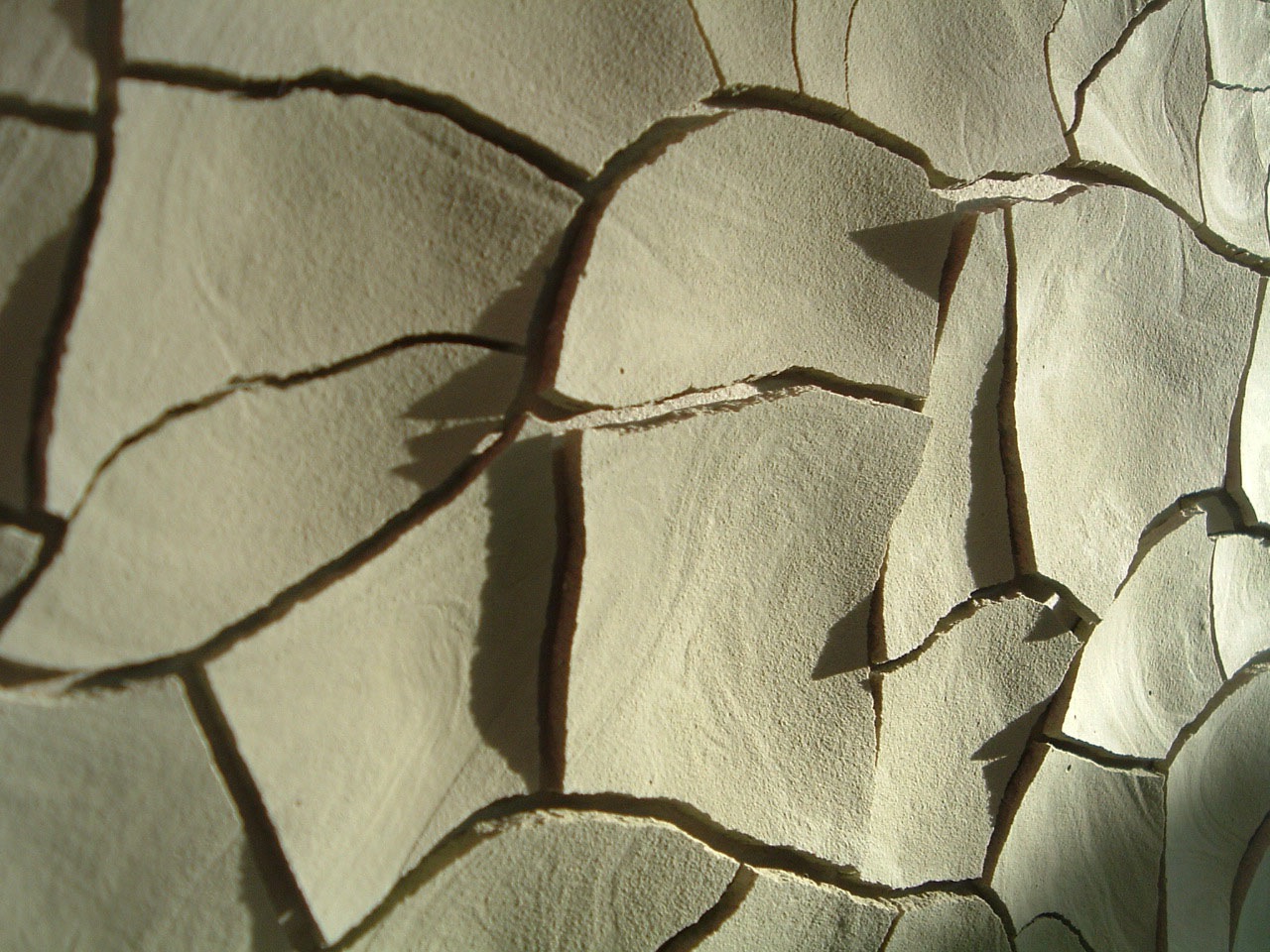
I sifted out all the rocks, twigs, animal bones and other detritus, and let the colored clay settle in large jars of water. After siphoning off the excess water, I poured this clay slurry onto large pieces of gypsum board to dry. The mud cracks were amazing art pieces in themselves.
Painting with Clay
After the clay slurry completely dried, I crushed and sieved each into a fine powder. I added a little linseed oil to the colored clay powder and in a frenzy of inspiration, I painted
The Paintings
What else can I say? Inspired by rocks, enchanted by Earth’s landscape…
Blessed by the exquisite anatomy of our hands and the infinite crossing points between the so-called right and left brain, we blend the vision of the imagination with technical know-how. We are the God Kings and Queens of Tool-Makers, and with these hands we make everything…
Art Meets Science: Glass
Blown Glass Baskets, Dale Chihuly
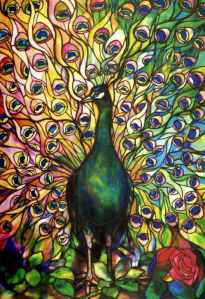
Discovered thousands of years ago, the science and technology of glass continues to enthrall and astound us. Quartz in the form of silica-sand is the primary constituent in window and art glass. Various oxides of calcium and boron, as well as colorants are added to the silica sand to give the glass the desired properties.
The first glass blowing techniques were developed in Syria over 2,000 years ago. Not much has changed in the methods or equipment since then, though the understanding of glass and melt behavior has certainly increased.
Science Meets Art: Porcelain Pottery with Copper Red Glaze
21st Century Copper Red Vase, Heather Mills, Christo Giles, New Zealand
Red is a difficult color to produce in a glaze (which is nothing more than a glass) but the Chinese discovered the technology ~5ooo years ago. Oxygen atoms are stripped from the copper oxides in the glaze during the reducing atmosphere of wood-fired kilns. Not only that, the copper particles suspended in the melted glaze must be approximately the same size as the wavelength of red light, or the color will not be red. Too small particles gives no color at all, and too large particles give a fleshy color that is only occasionally attractive. Click here or on the image above for more information about copper red glazes.
Art Meets Science: Red Paint
Cochineal Beetle
Back in the day of the Alchemists, before the Periodic Table of the Elements had been invented, artists made their own paints, by grinding minerals from the landscape (or bugs) into powder, adding a binding agent, and voila! oil paint! Red and purples were beastly difficult to make. Red dye could only be produced by the crushed carcasses of the insect Cochineal, found mainly in Mexico and South America. The famed Red Coats that Paul Revere warned the countryside about had been dyed with Cochineal.
These days, artists use commercially-prepared paints. Red? No problem! Cadmium, from the Periodic Table is used to make both red and yellow oil and acrylic-based paints–another technological innovation in painting https://en.wikipedia.org/wiki/Acrylic_paint.
Art Meets Science: Yves Klein International Blue
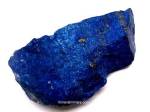
Back in the late 1950’s, the French artist Yves Klein, with the aid of Edouard Adam, a Parisian paint dealer, developed a pigment known as IKB (International Klein Blue). Using an alternative to the traditional linseed oil base, which tends to cloud the color, Klein produced a paint the color of the mineral lapis lazuli.
Lapis LazuliIKB – International Klein Blue
Klein’s purpose was not only to make a better blue; he wished to evoke the “authenticity of the pure idea.” Prior to IKB, his monochromatic paintings had been of a variety of colors and people reacted to a gallery showing of them as if they were each a part of a mosaic. Not what he had in mind…read more here (http://en.wikipedia.org/wiki/Yves_Klein)
Science Meets Art: The Art of Science Competition, Princeton University
In 2011, 20 university departments submitted 168 pieces of art to a competition sponsored by Princeton University, around the theme “Intelligent Design.“
Click on image below to view 11 of the 56 works chosen. Nothing more needs to be said, other than: “Where are the other 44?”

 Bones of Metal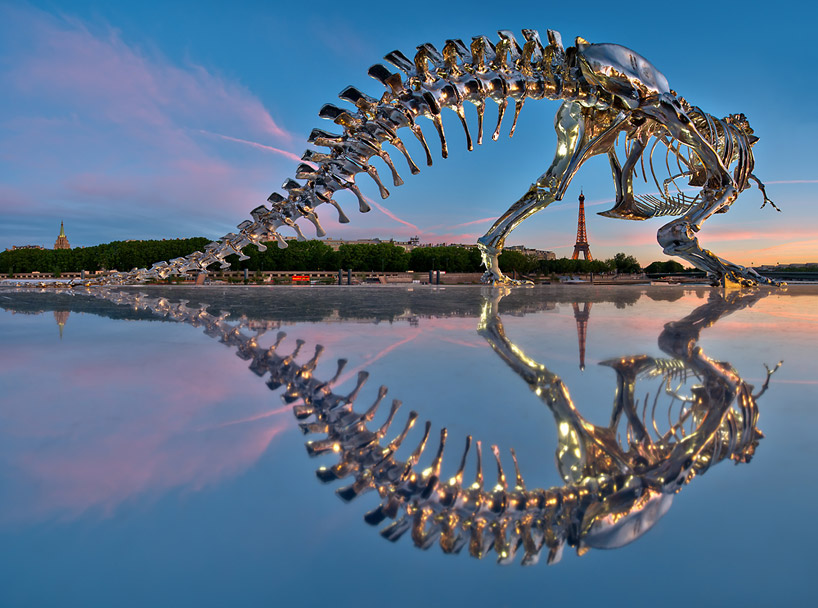

 Bones of Clay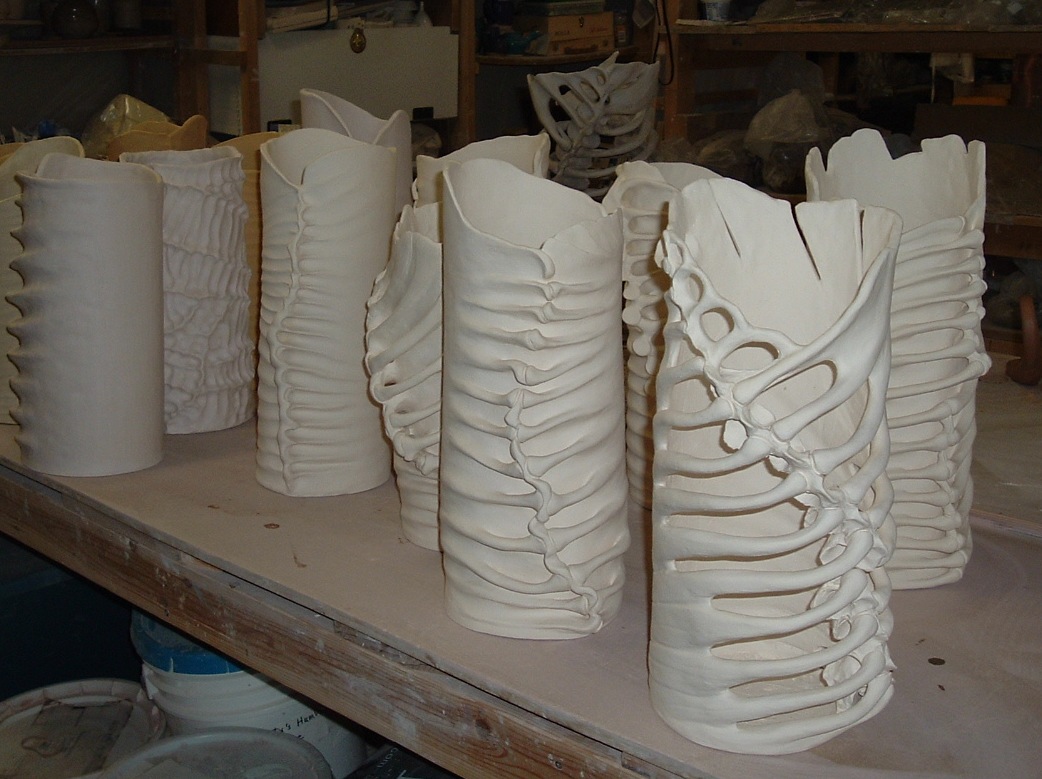








 Mary C Simmons ... Art and Word
You must be logged in to post a comment.